Safari Njema

IMG_0585

Cross one off the bucket list, folks!  Today I went on my first safari!

Although I just left for Ifakara last week, I found myself making the trip back to Morogoro two days ago.  When I arrived at the language school campus (where they were kind enough to let me stay for a week so I could see friends before heading to my field site) after my stay in the States, I learned that the language school was planning on taking students and teachers on safari the Saturday after I was scheduled to leave.  I was majorly disappointed to miss this, not only because I still hadn’t been on safari, but also because going with friends seemed like fun and since the language school was providing transportation, it would be much more affordable than going on my own.  Fortunately, the head teacher said that I would be welcome to join them if I wanted to.

And so, exactly one after arriving in Ifakara, I left again.  I took the bus six hours back to Morogoro and had another mini reunion with my friends there Friday night.  I had no idea what to expect with the safari.  There were only about five students and I knew that many of the teachers had opportunities to go with each class, and so I only expected maybe two or three of them to be interested.  I assumed we’d take one of the school’s SVUs that has extra folding seats in the back and would just cram in.  Well we did cram in.  But I drastically underestimated our numbers.  When I walked out early Saturday morning after breakfast, a bus stood in the drive.  A full-on bus.  “Well this is nice in a way,” I thought.  “We’ll have room to spread out and everyone will have a window.”  I should have known better.  After all, this is Tanzania.

Only a few teachers were on the bus, so I and the two students with me entered and took window seats on the left side of the bus.  As we waited, more and more people filed in, filling up the single seats on the left and the double seats on the right.  Some were teachers.  Some were former students like me.  Some were family members of teachers.  Soon we had a full bus.  But we weren’t done yet.

We pulled out from the language school around 7am, an hour later than hoped, but rather than take the highway out of Morogoro as I thought we would, we drove into some of its neighborhoods, picking up even more people that I didn’t recognize from the side of the road.  I assume they were more friends and family members of teachers.  Soon, all of the fold-down seats in the aisle were full, some with two people squished in, plus a couple more standing up at the front of the bus.  It was fairly uncomfortable and I was curious how the safari would work.

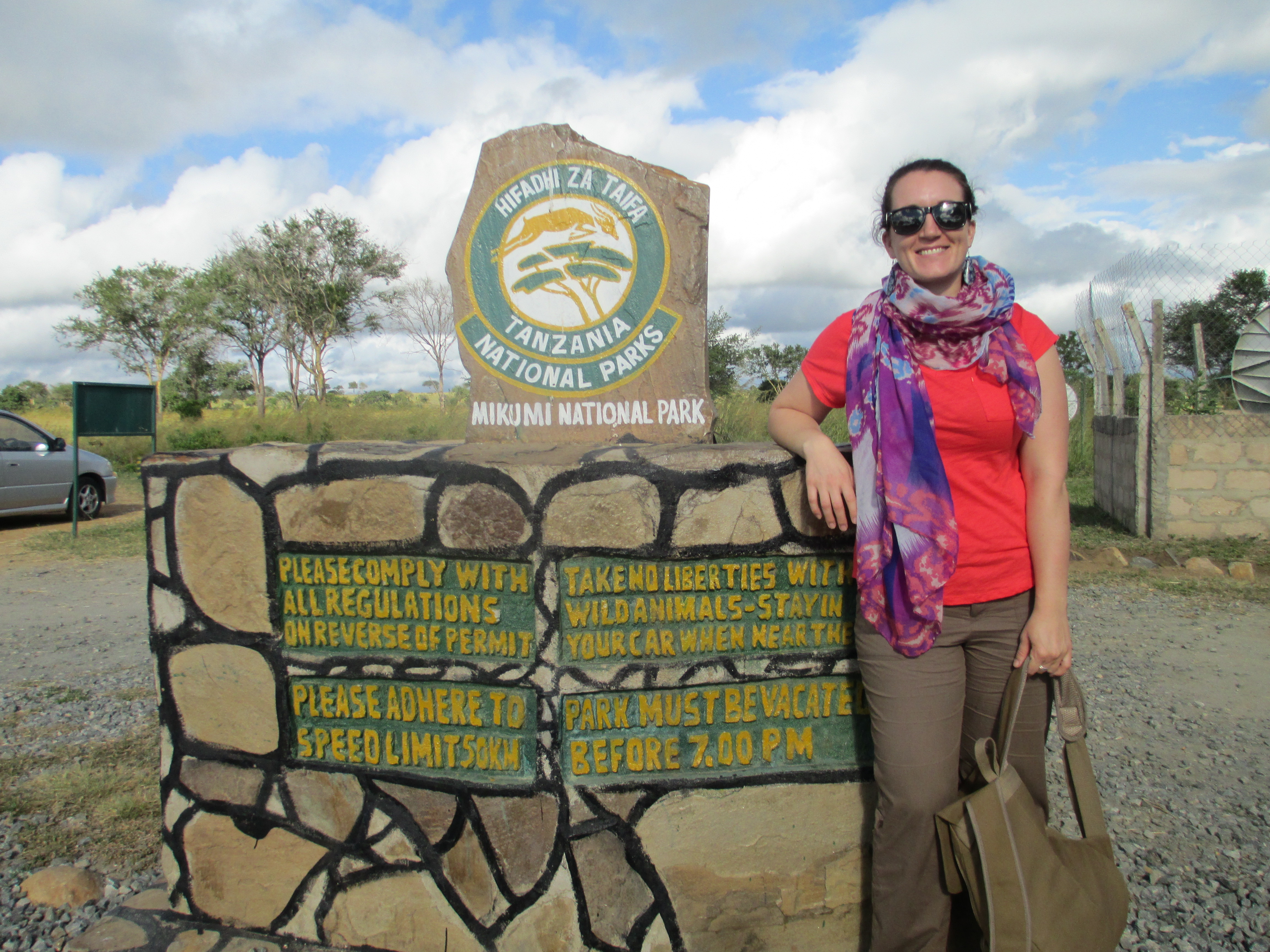
IMG_0561The trip to Mikumi National Park was quiet- most of us were catching up on sleep given the early morning.  We pulled into the main entrance an hour and half later, and it took some time for us all to pay our entrance fees, use the bathrooms, etc.  But eventually we all made it back onto the bus, settled in, and sat waiting patiently for our guide to start.
IMG_0564

Let me give you some advice.  A packed bus full of people can make for a great experience when you’re talking about a party bus headed to a concert.  Or a school field trip.  Or a city tour.  Even a dilapidated old machine carrying you and several squawking chickens down the mountain on the Most Dangerous Road in the World in Bolivia can be a great time if you have friends who are wise enough to bring Tampico and Singani along.  One thing a packed bus is not meant for?  Safari.  Aside from the obvious pitfalls of trying to take a bus on dirt roads meant for SUVs, you have the noise factor with that many people which distracts the animals.  It is likewise awkward to look out the window and try to take pictures or enjoy the scenery when animal spotting brings everyone in the middle of the bus lunging over you.  In addition, our guide, who spoke very good English, was excited to have Tanzanian tourists and so kept giving long complicated monologues in Swahili with vocabulary I didn’t know to the teachers and their friends and then, when we would ask him for the English version, would give us one word or one sentence answers.  It was clear he knew a fair amount of information on the different animals, so it would have been nice to understand more.  Also, someone had taught him that the best word to use to describe animal waste was not scat, feces, excrement, or even poop, but rather “shit.”   Which was not only amusing, but somewhat scandalizing to certain missionary members of our party.  There is a lot of discussion about animal waste on safari, let me tell you, so the word peppered the conversation frequently.

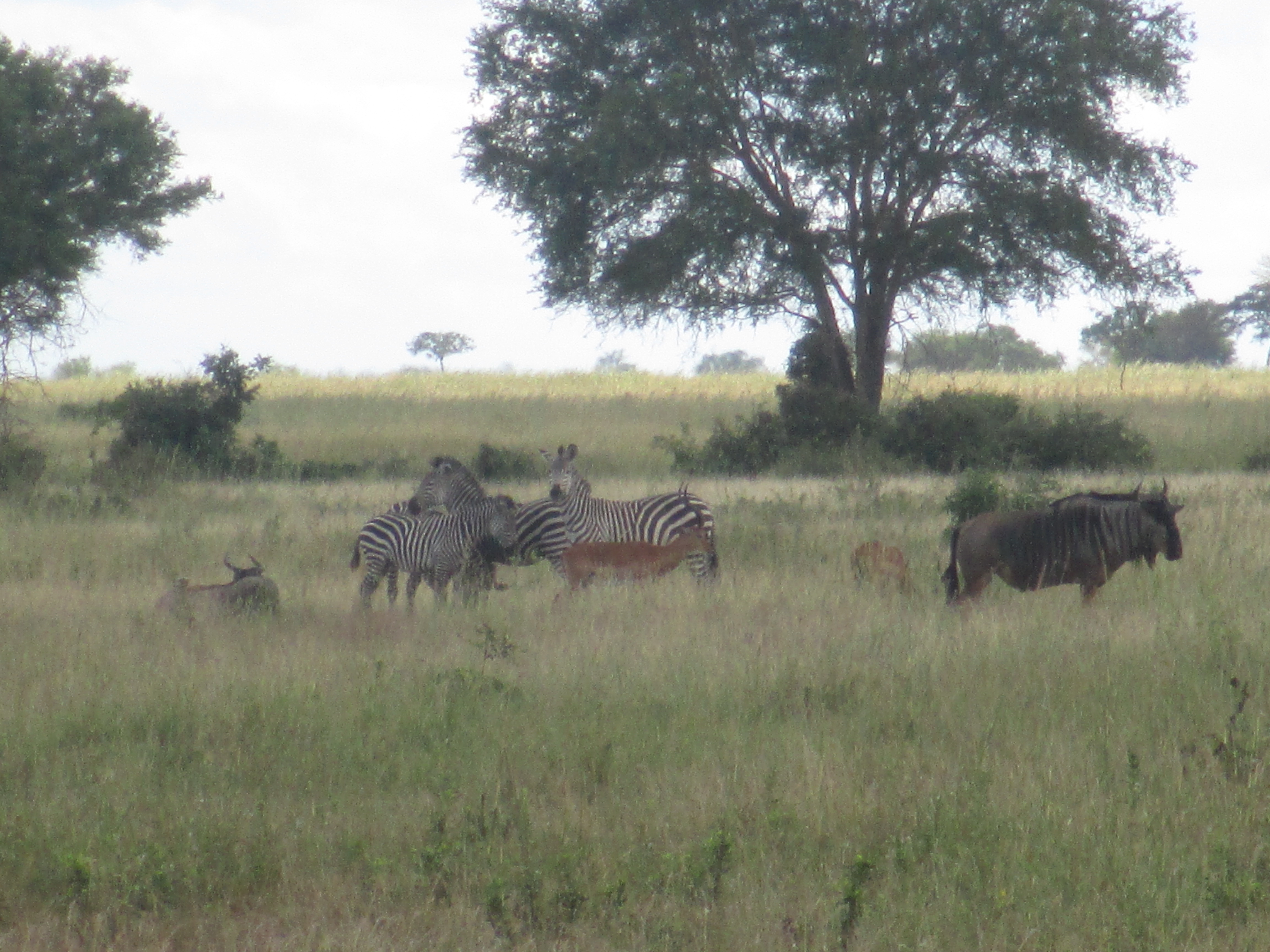
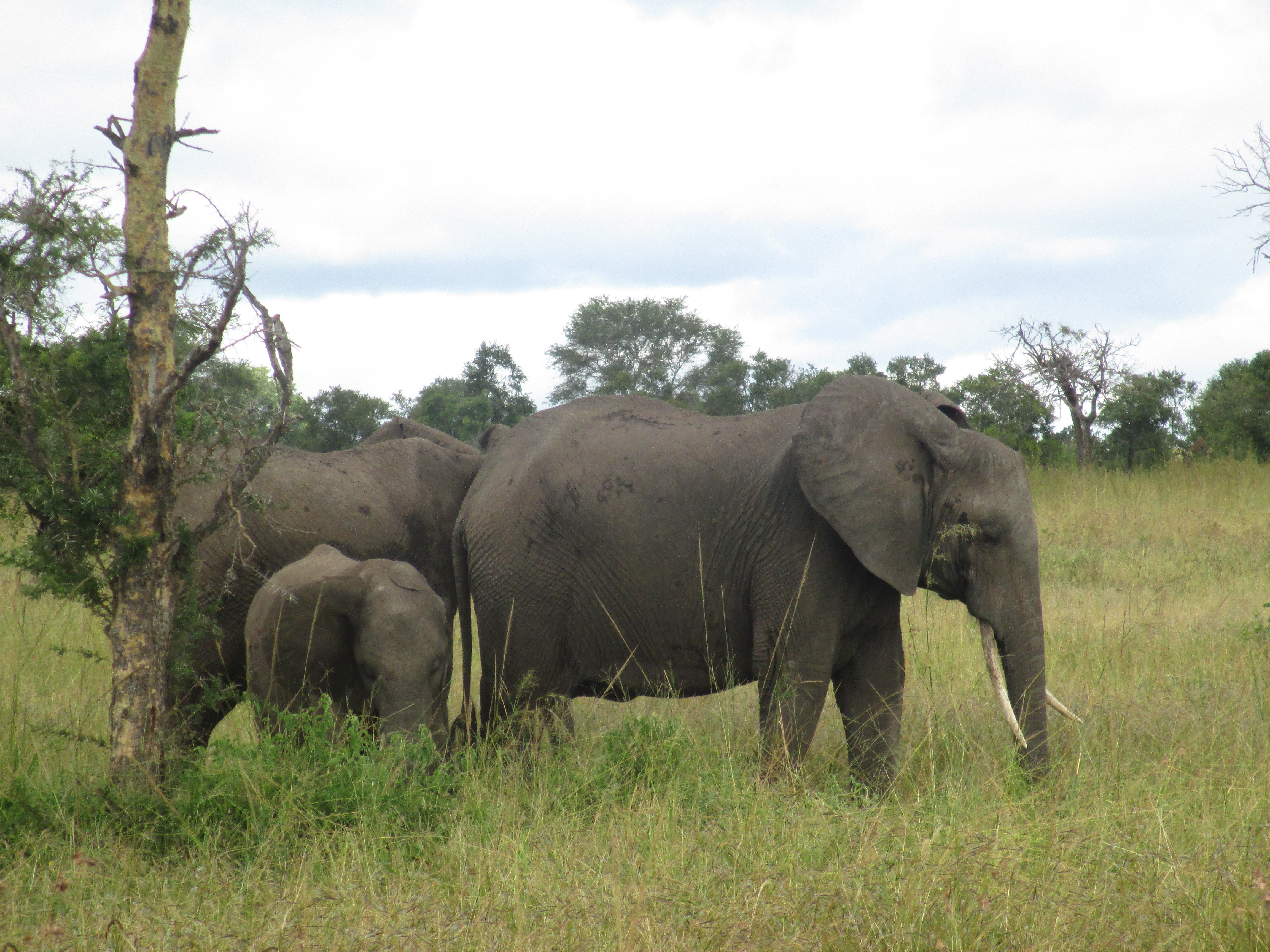
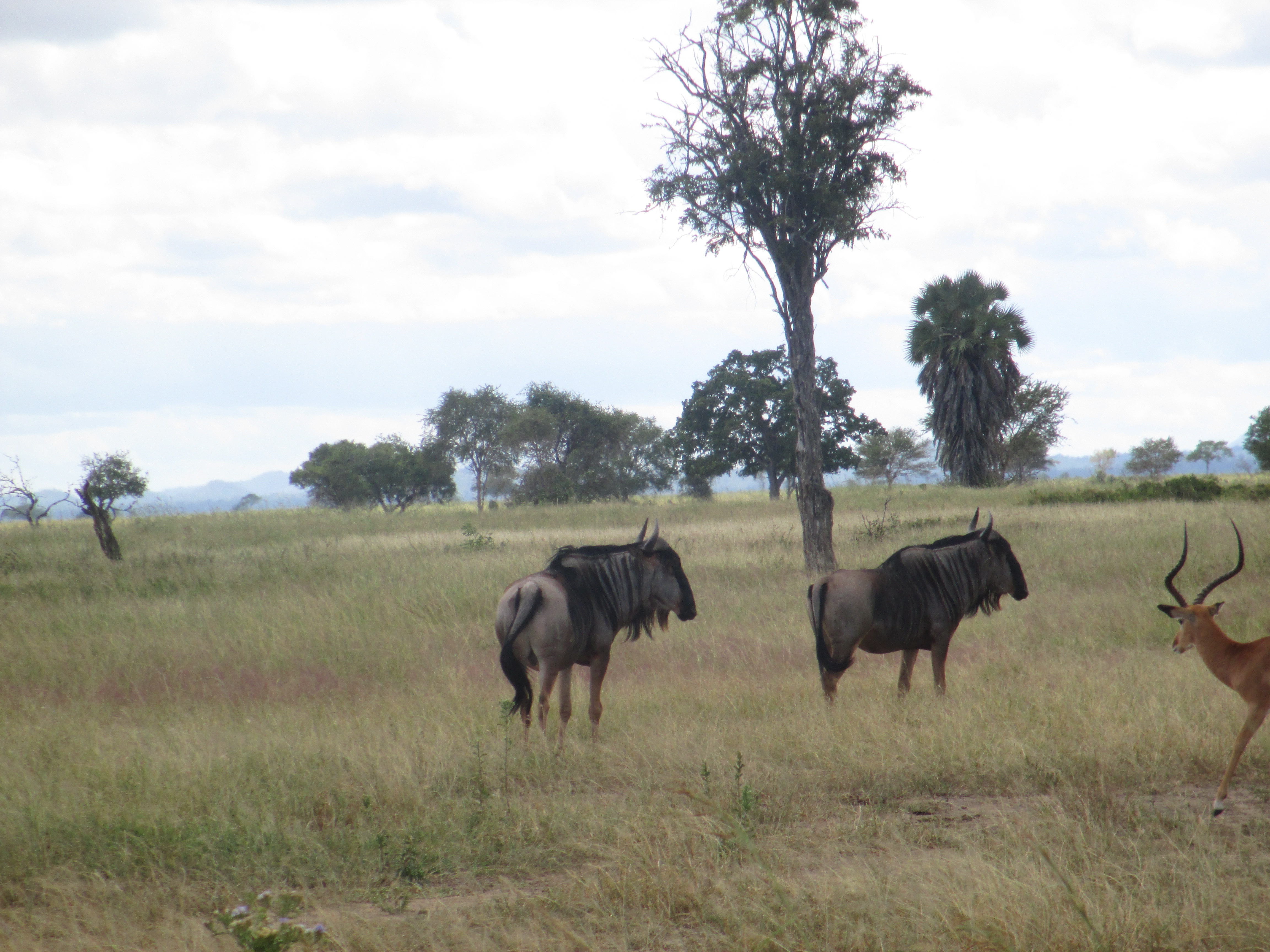
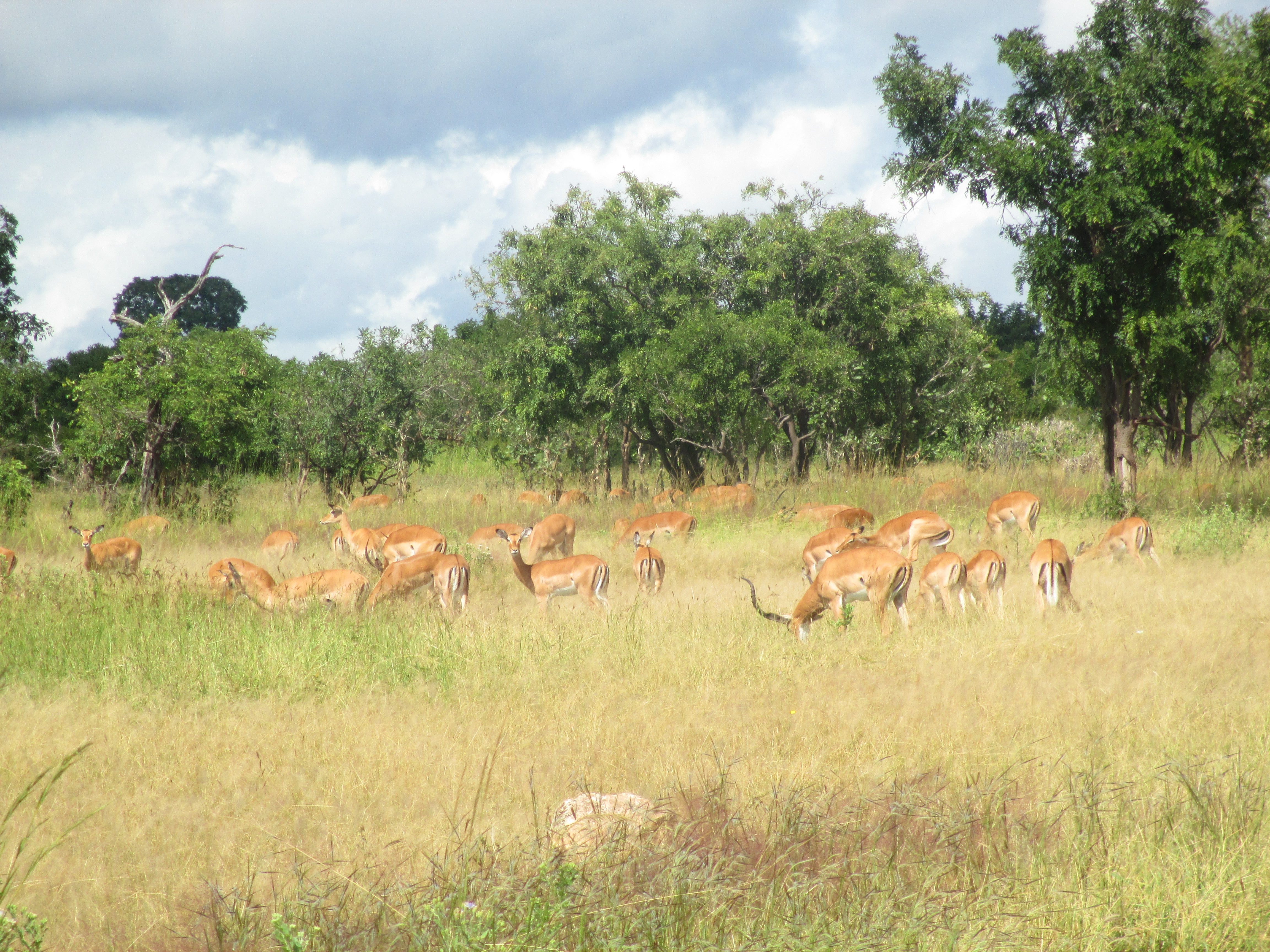
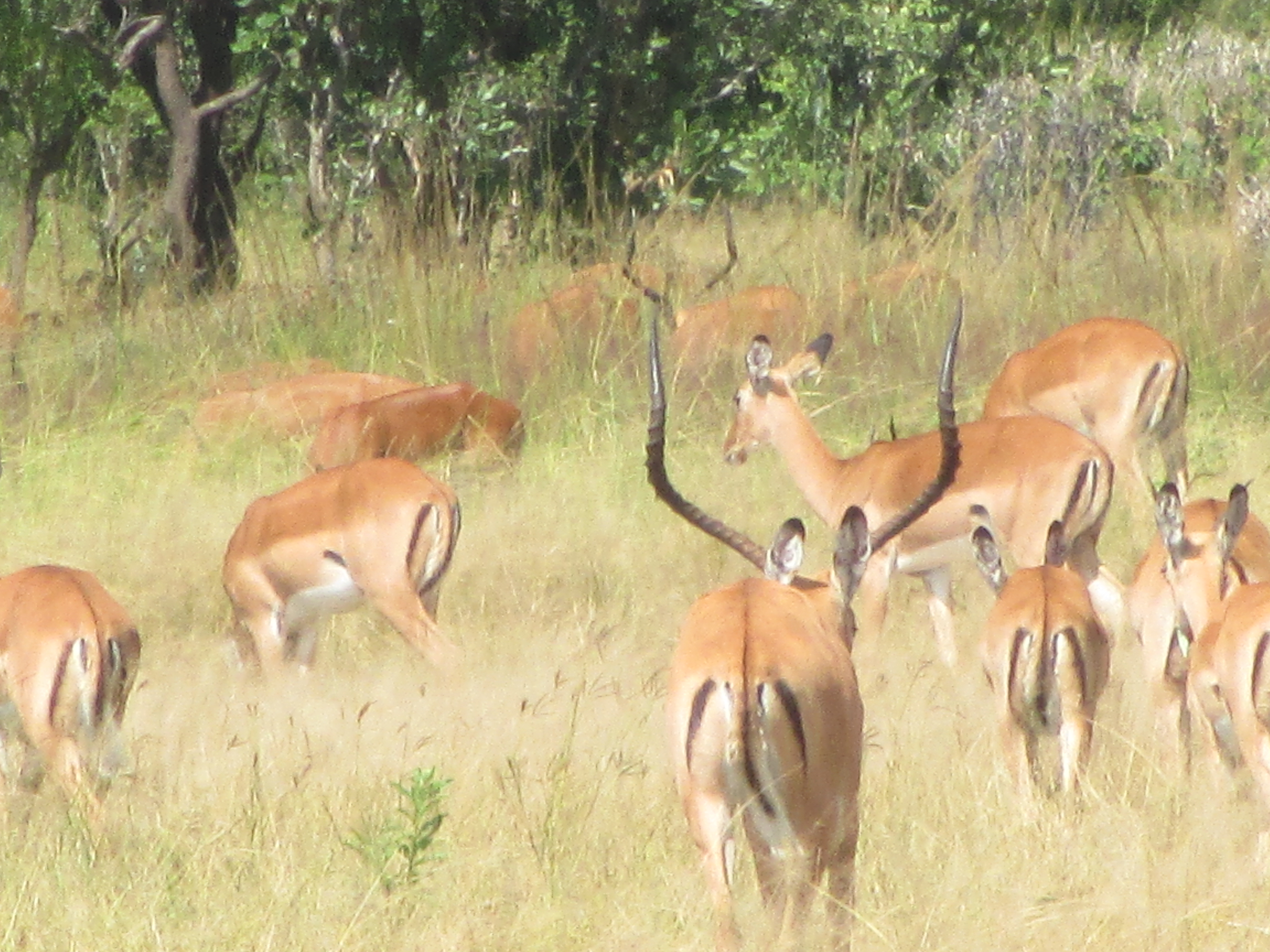
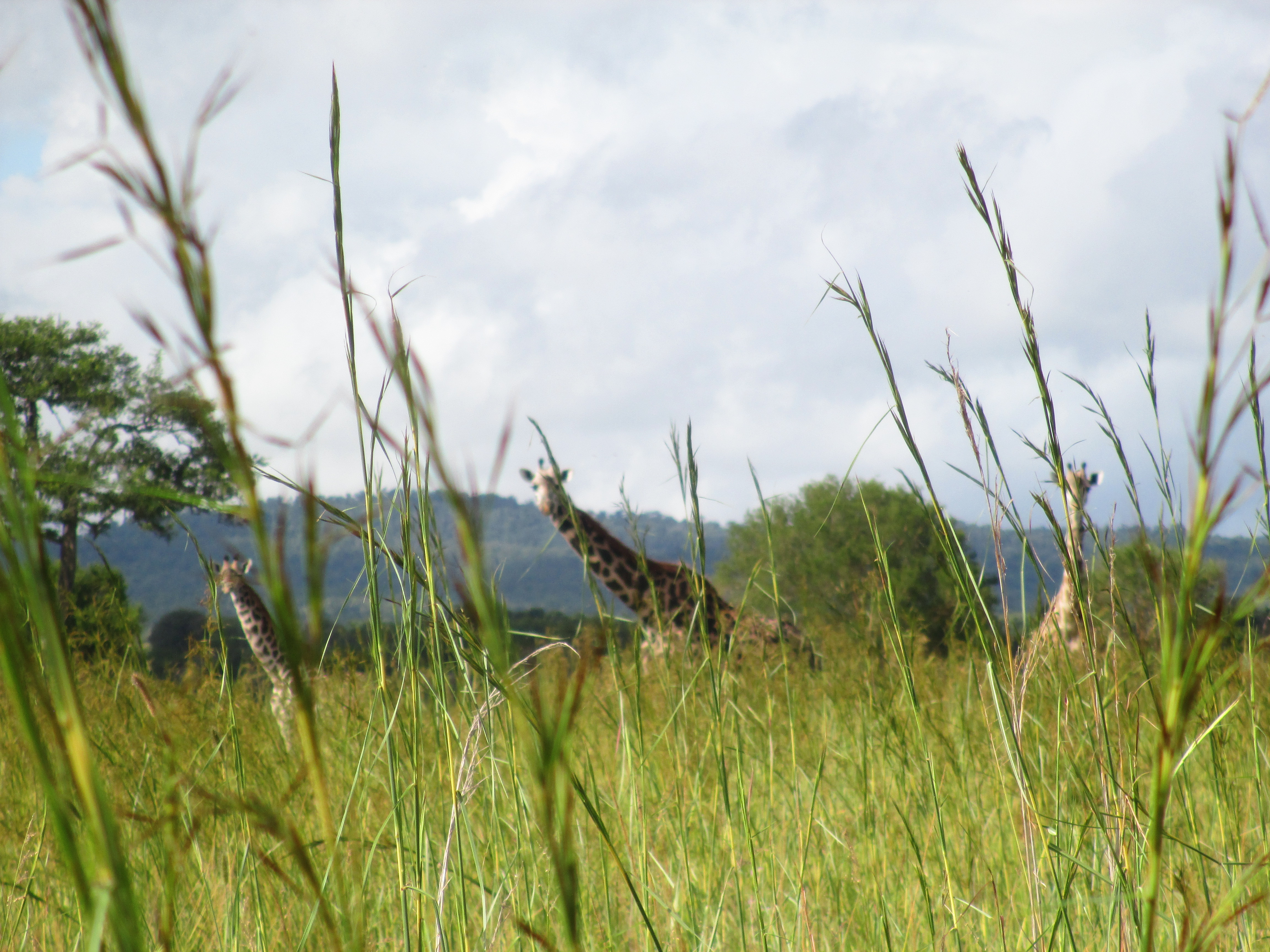
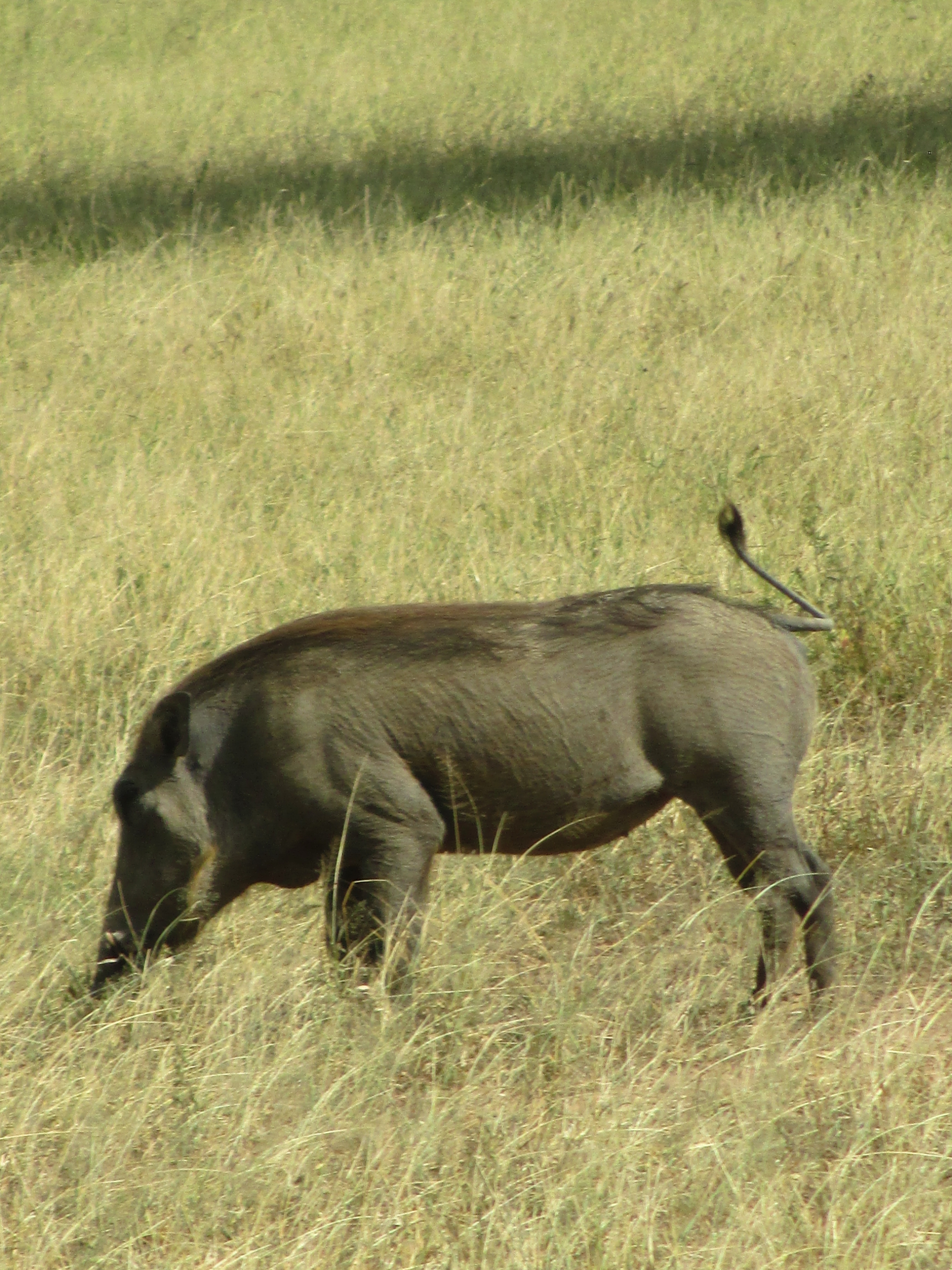
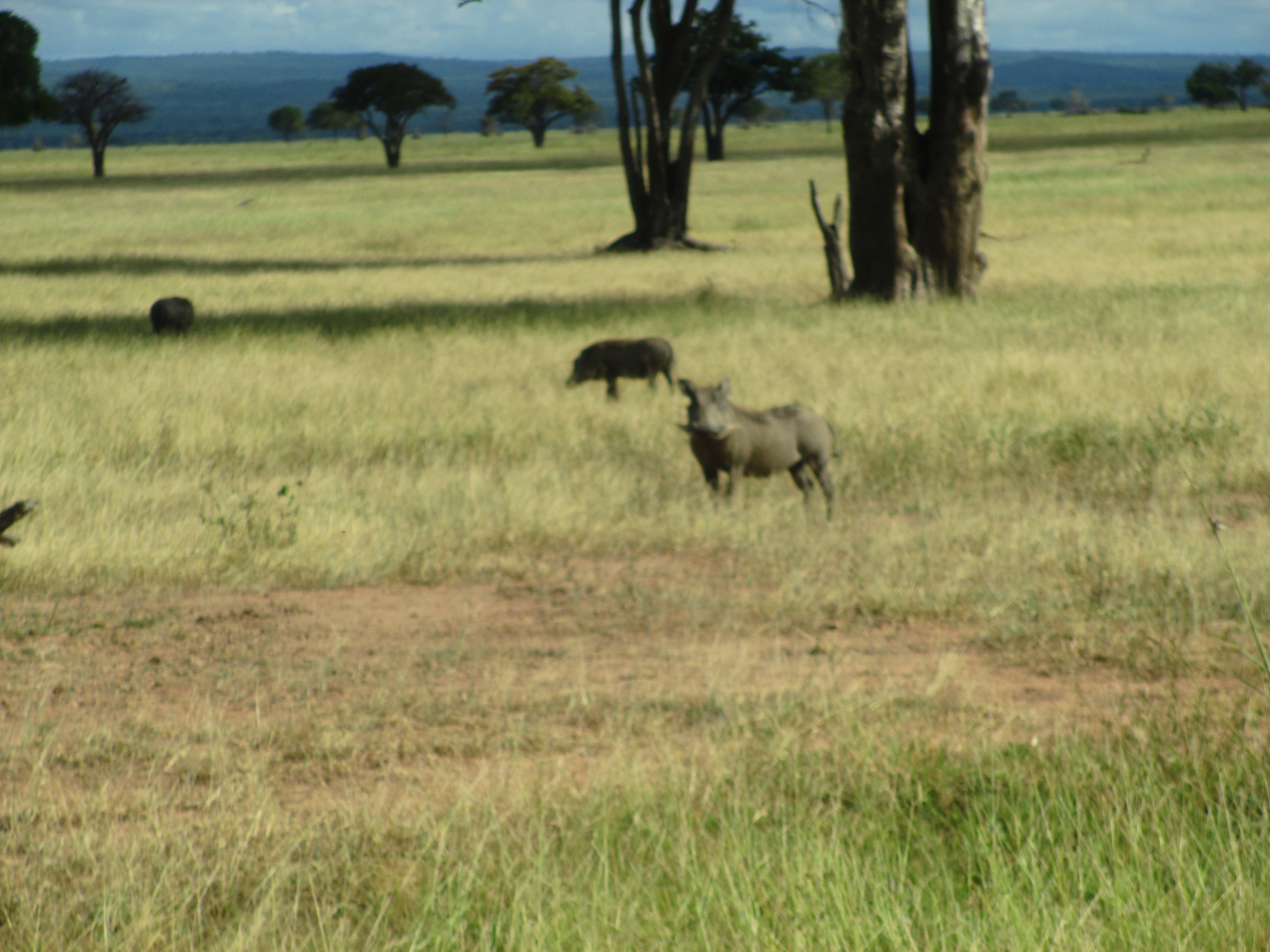
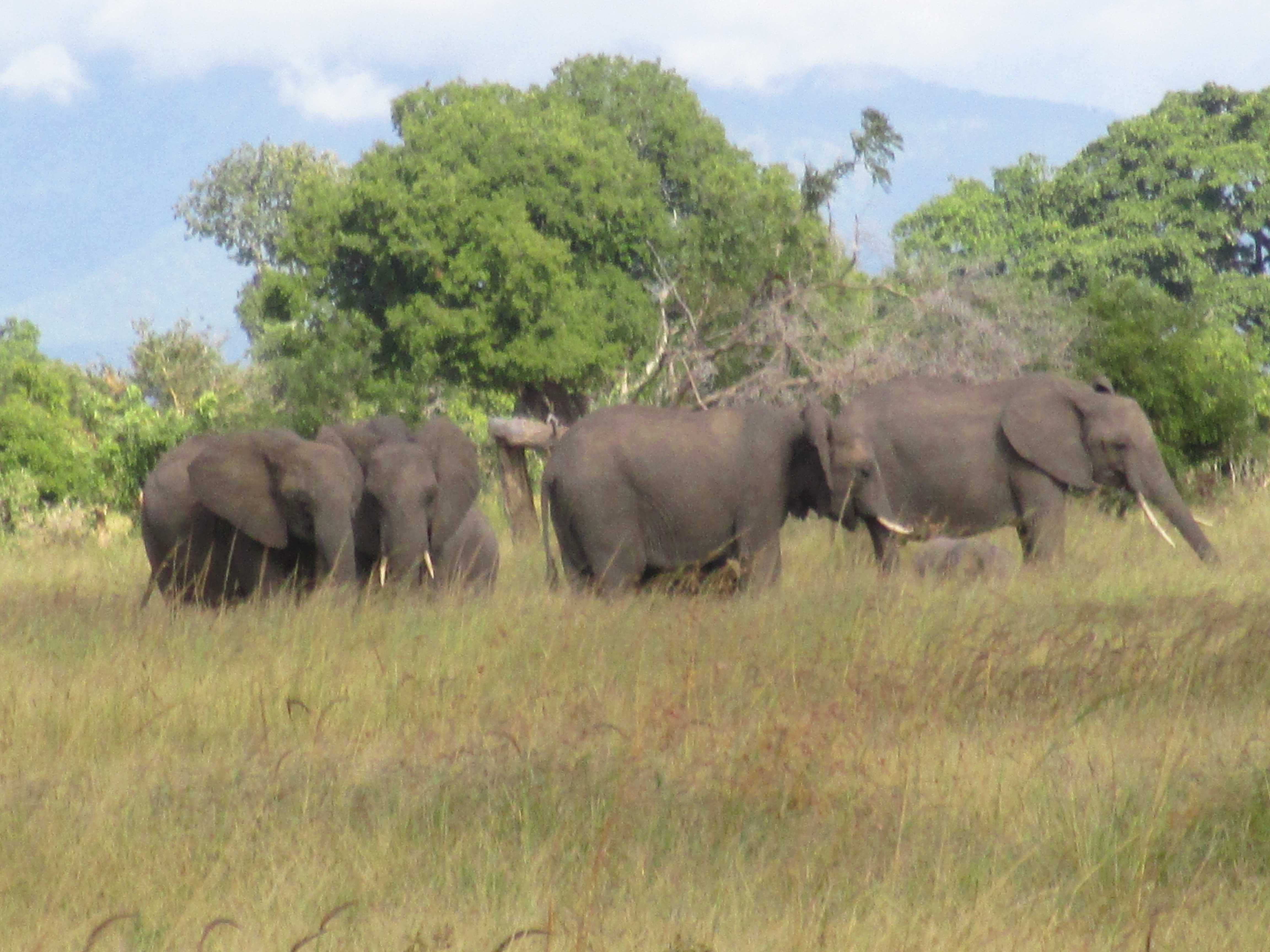
Enough complaining though.  Although it was not ideal circumstances, it was still a great experience and a fun introduction to the world of Tanzanian safaris.  It was low season, so we did not see the huge numbers of animals that you see during high season, but in terms of species I felt fortunate in the variety.  As soon as we left the front gates, we were treated to a small herd of elephants (Tembo), complete with two elephant calves.  I’ve been a bit of a fan of elephants since I was a child (first just because I liked my issue of Zoobooks on them, but later because I found out about their matriarchal family structure which appeals to the feminist in me).   Three warthogs (Pumba) grazed nearby.  As we traveled on, we encountered numerous giraffes (Twiga), zebras (Punda milia), a large heard of gazelles (Swala), hippos (Kiboko), wildebeests (Nyumbu), and water buffalo (Nyati).  Unfortunately I was working with a pretty cheap camera, a moving vehicle, and foggy windows, so my pictures leave something to be desired.
IMG_0607

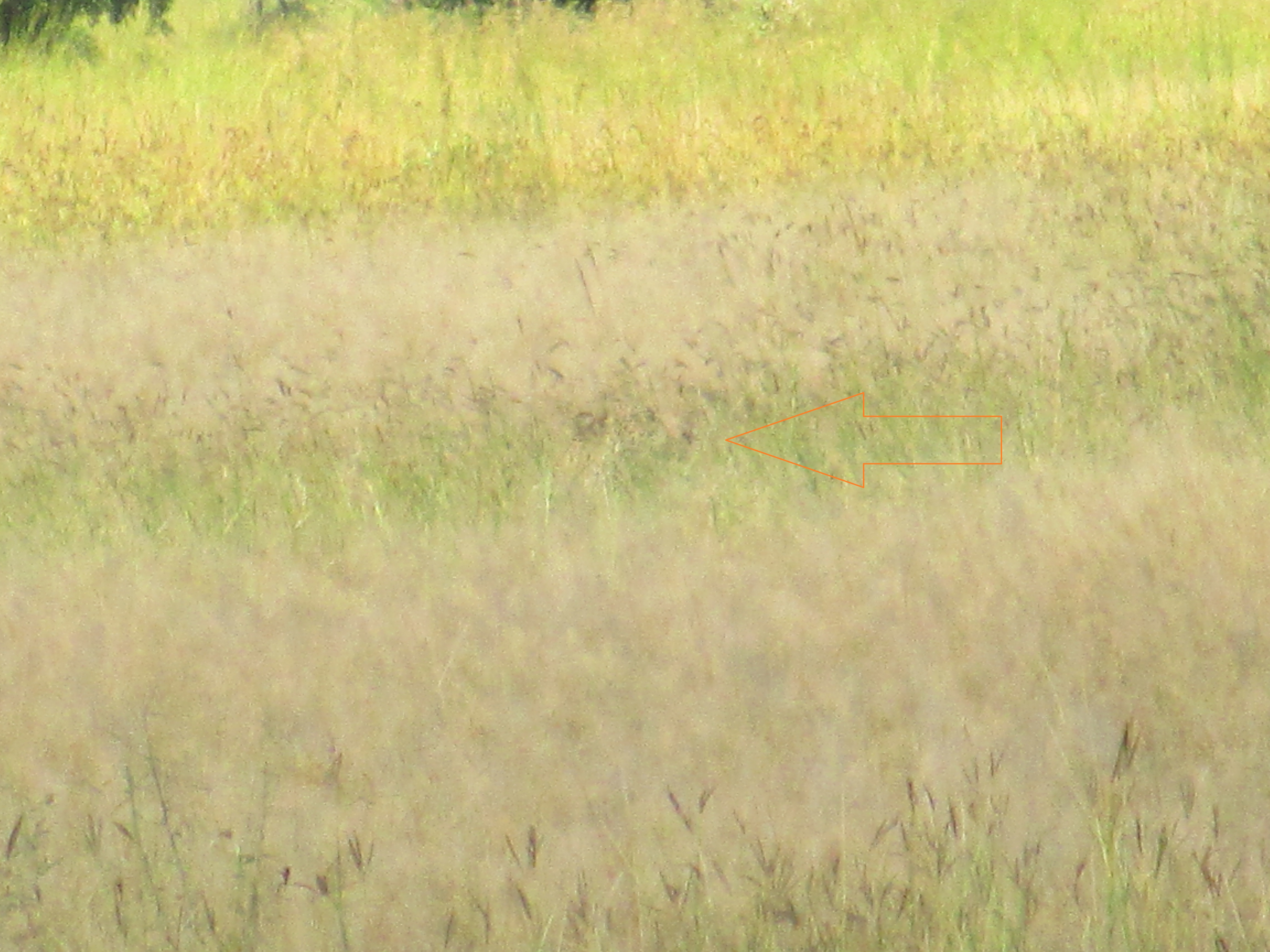
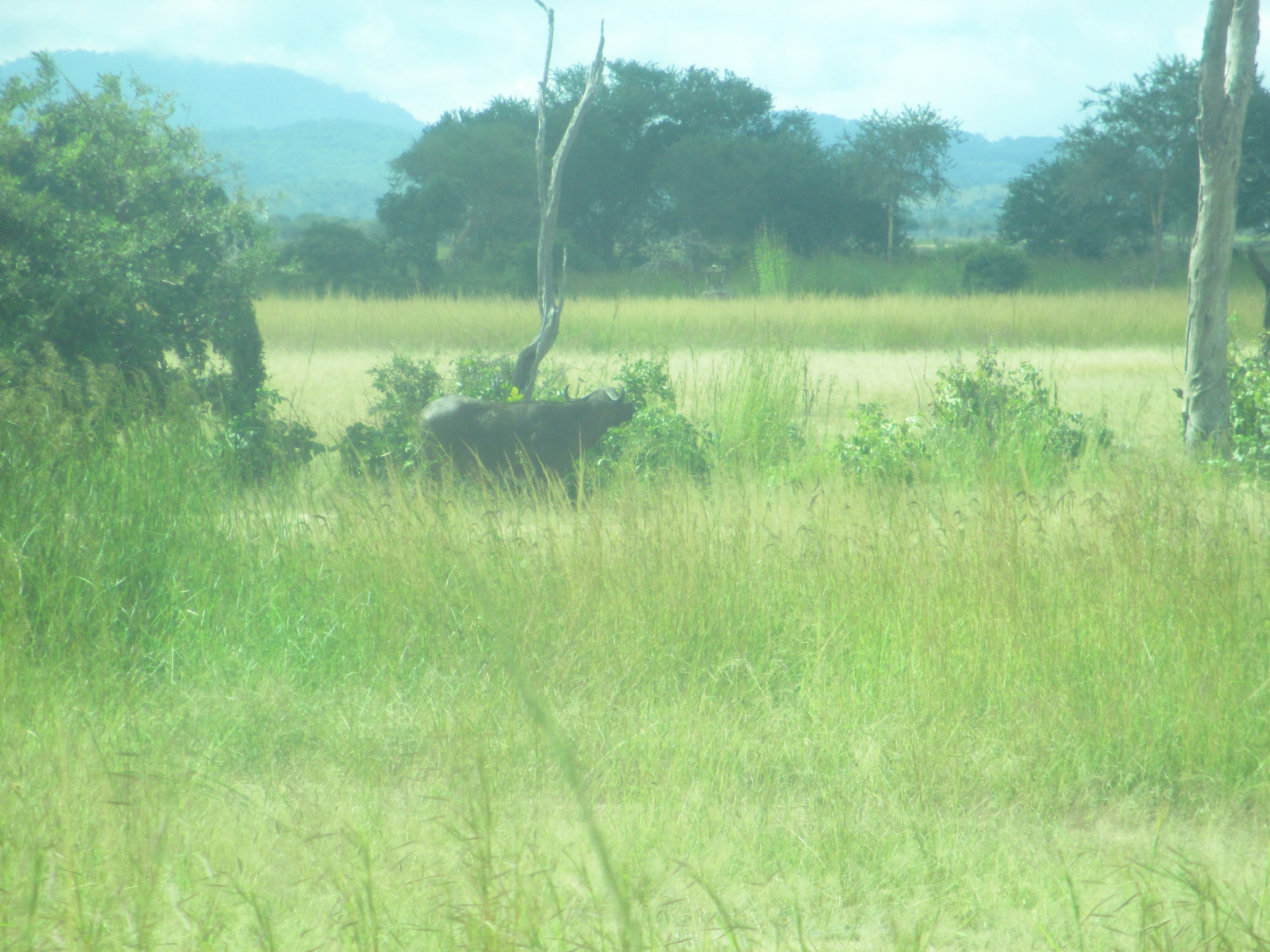
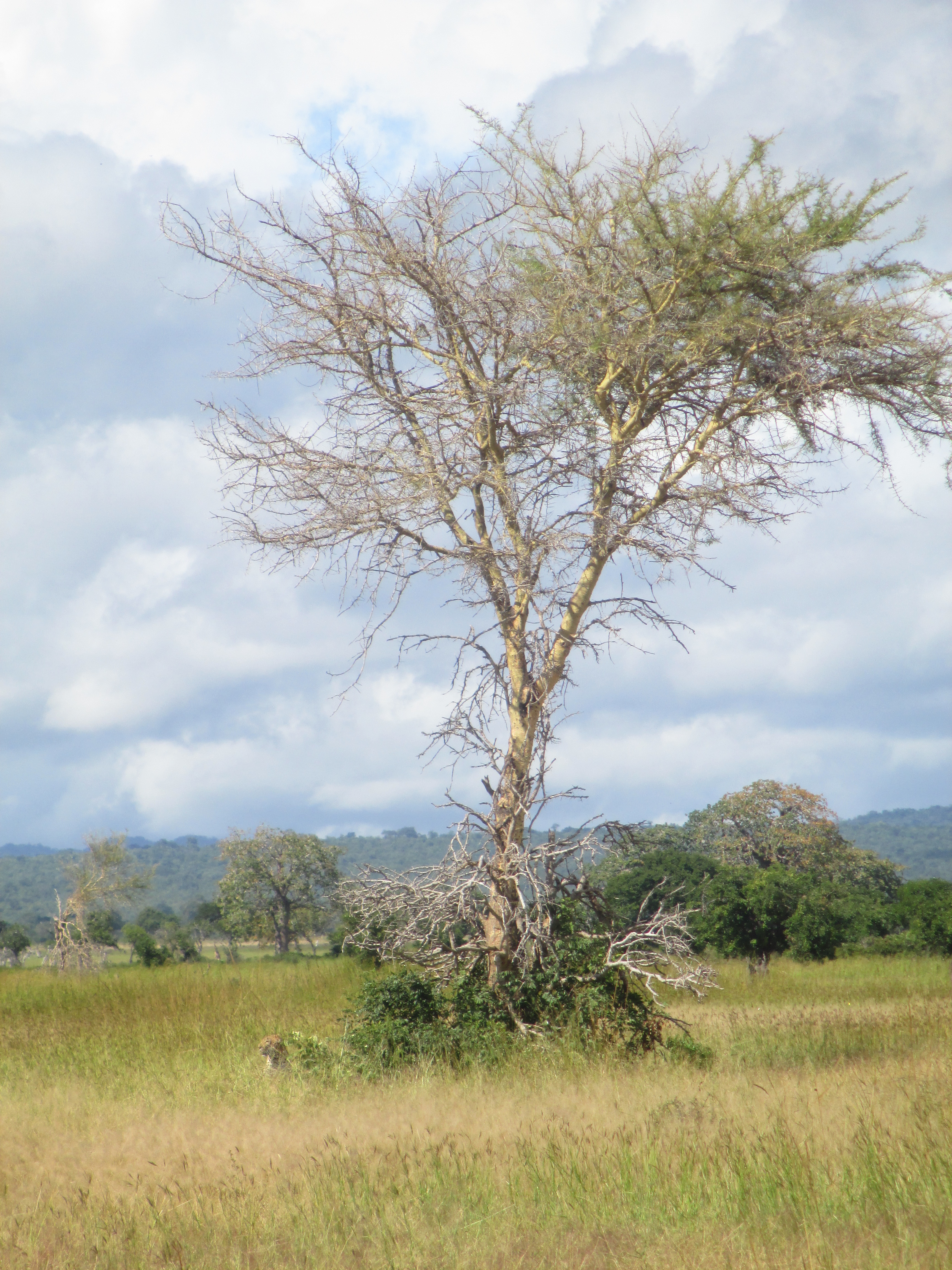
But the real highlight of the day came midway through the drive.  We had stopped to look at a lone water buffalo grazing in a field.  He wasn’t doing much and really you can only watch what is essentially a large cow eat grass for so long, so we started to creep forward in the bus to continue our journey.  Suddenly, someone spotted something in the grass nearby.  We weren’t sure what it was at first, but suspected the slightly darker spot in the grass might be a lion (Simba).  We sat as quietly as thirty people on a bus can sit (in other words, not that quietly) while we debated what it was and tried to zoom in with our cameras to get a better view.  For a while it was crouched too low in the grass to see, but eventually it raised its head enough for us to verify that it was indeed a large cat.  Our guide told us it was a lioness, others in the group thought it might be a leopard (Chui).  Our guide shook his head.  “You almost never see leopards,” he told us.  “It never happens.  It is definitely a lion.”  But eventually the cat sat up enough and we were able to use binoculars to determine that indeed, we were looking at Chui!  It was incredible how well it blended in with the surroundings, and that we even caught a glimpse of it in the first place.  We sat for a long time watching, hoping that the cat would make its move on the buffalo but it was obviously bothered by us.  It kept looking back and forth between our bus and the buffalo.  Not wanting to interfere longer, we moved on.

IMG_0609 modifiedIMG_0612 modified

IMG_0615

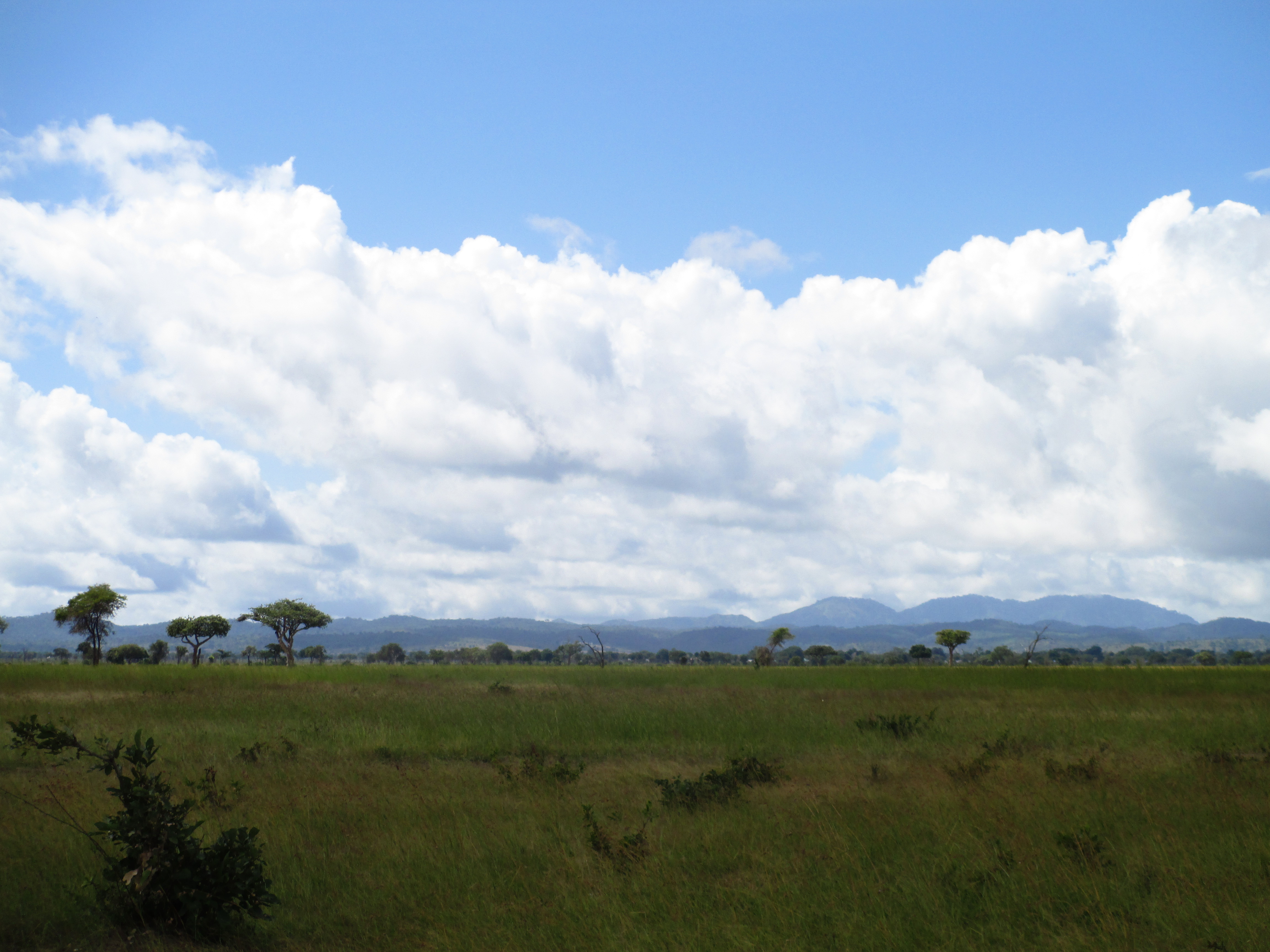
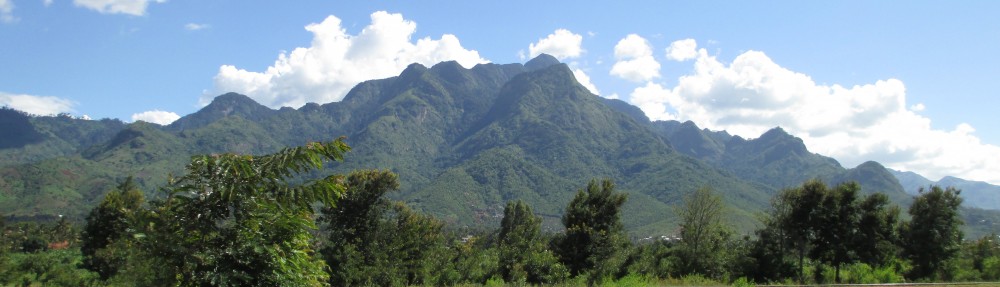
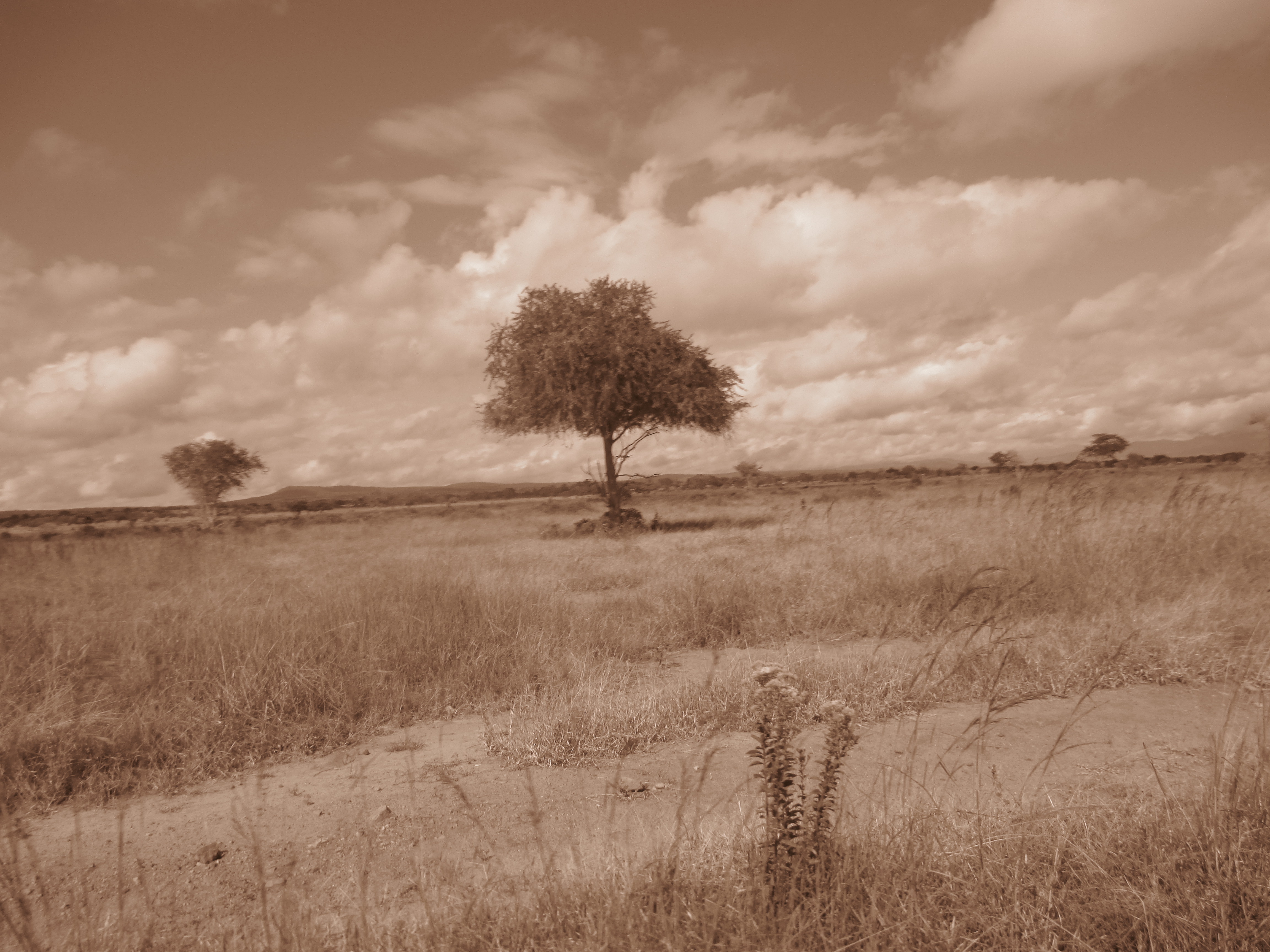
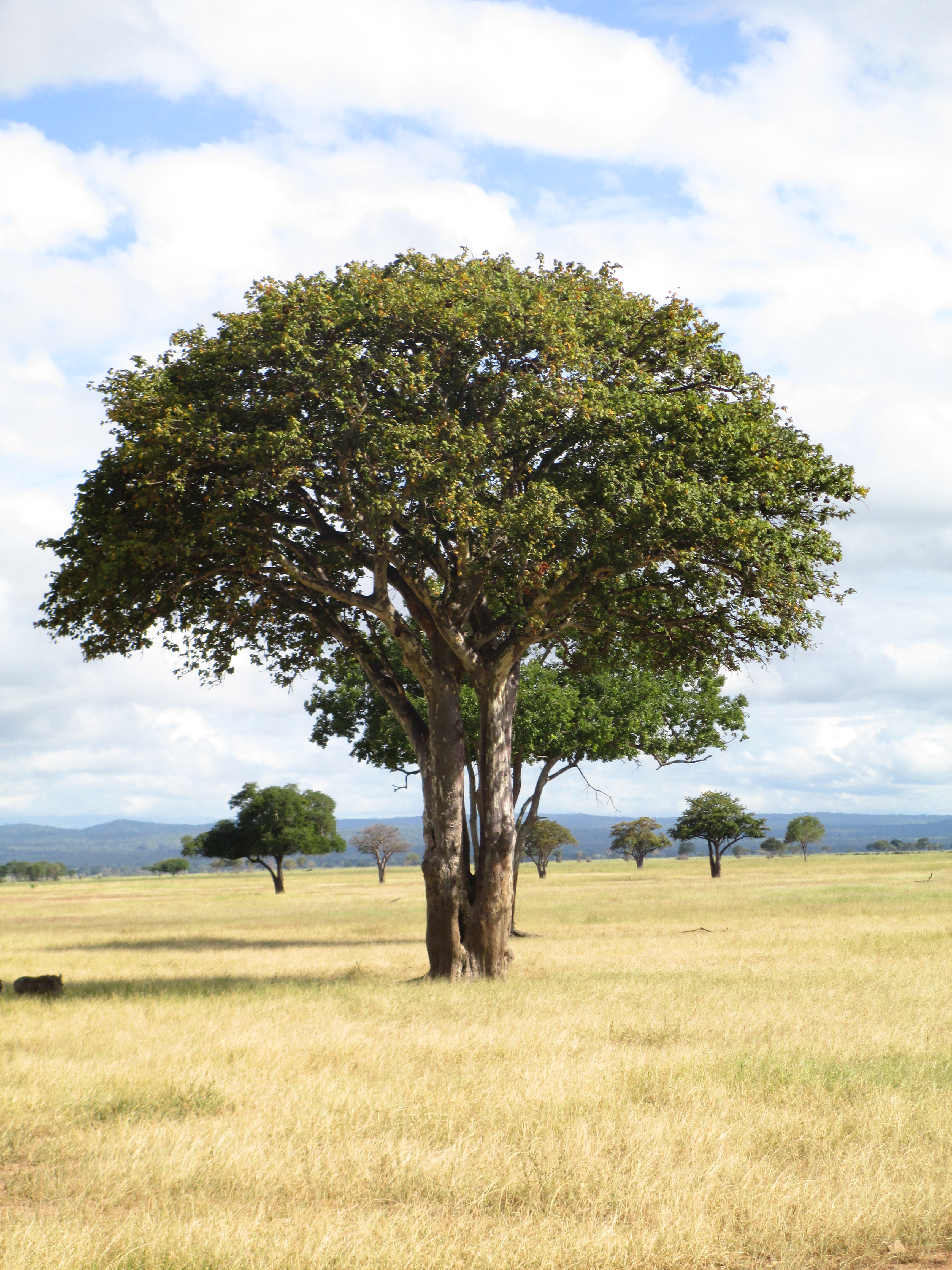
All in all, I felt pretty incredibly lucky to see what we did, and also just to get to enjoy the stunning landscape.  I would still like to do a safari the more traditional way, with just a handful of people in an open air vehicle, but I feel like I at least got to experience it once.  A safari involves a lot of just driving, so there isn’t much else to share about the day, but I wanted to share a few pictures and highlights!
IMG_0581IMG_0617 IMG_0639IMG_0643

  IMG_0635 IMG_0627 IMG_0621 IMG_0620     IMG_0608  IMG_0604 IMG_0593IMG_0601 IMG_0577 IMG_0590  IMG_0576 IMG_0573

A Night For Netball

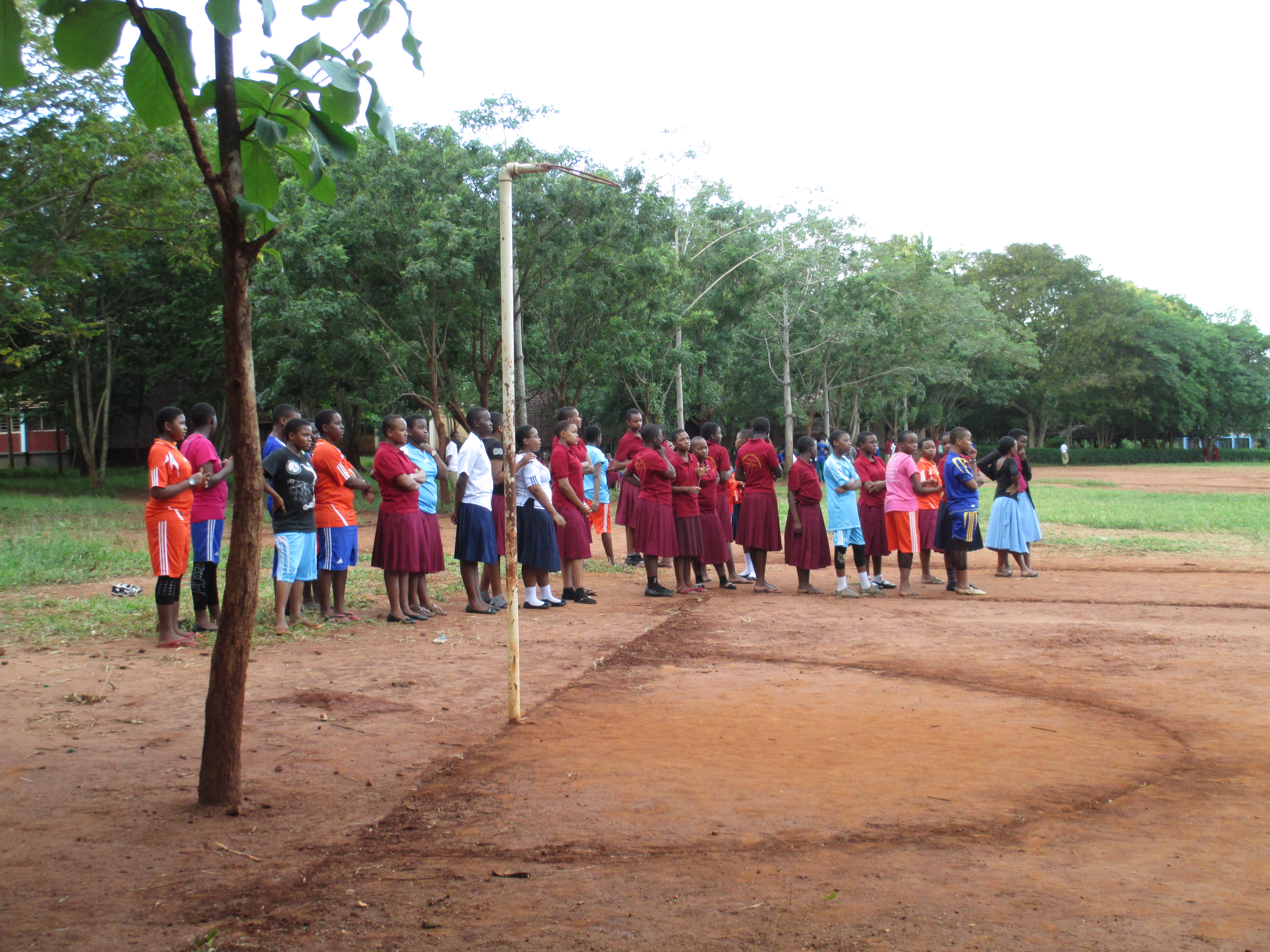
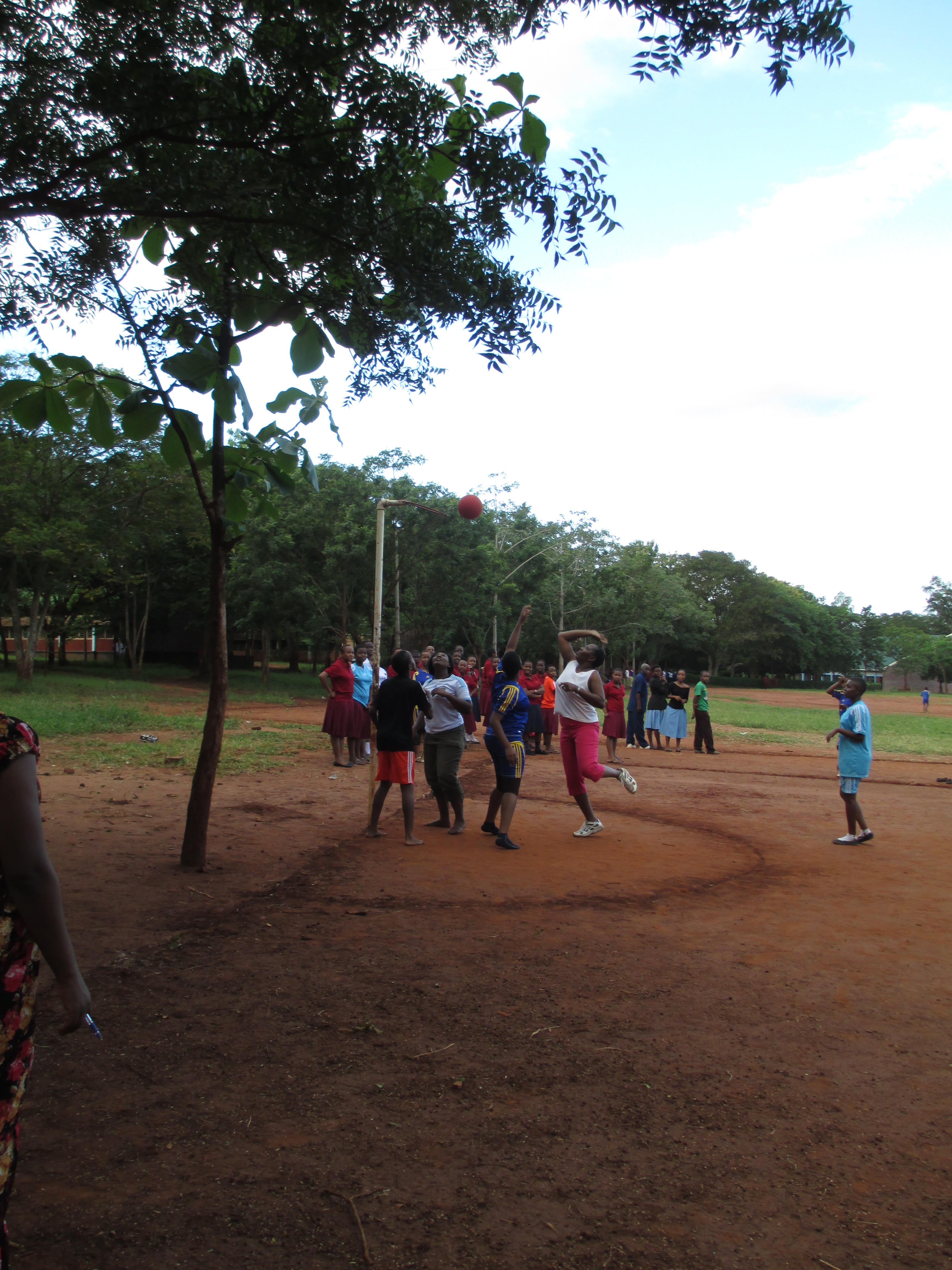
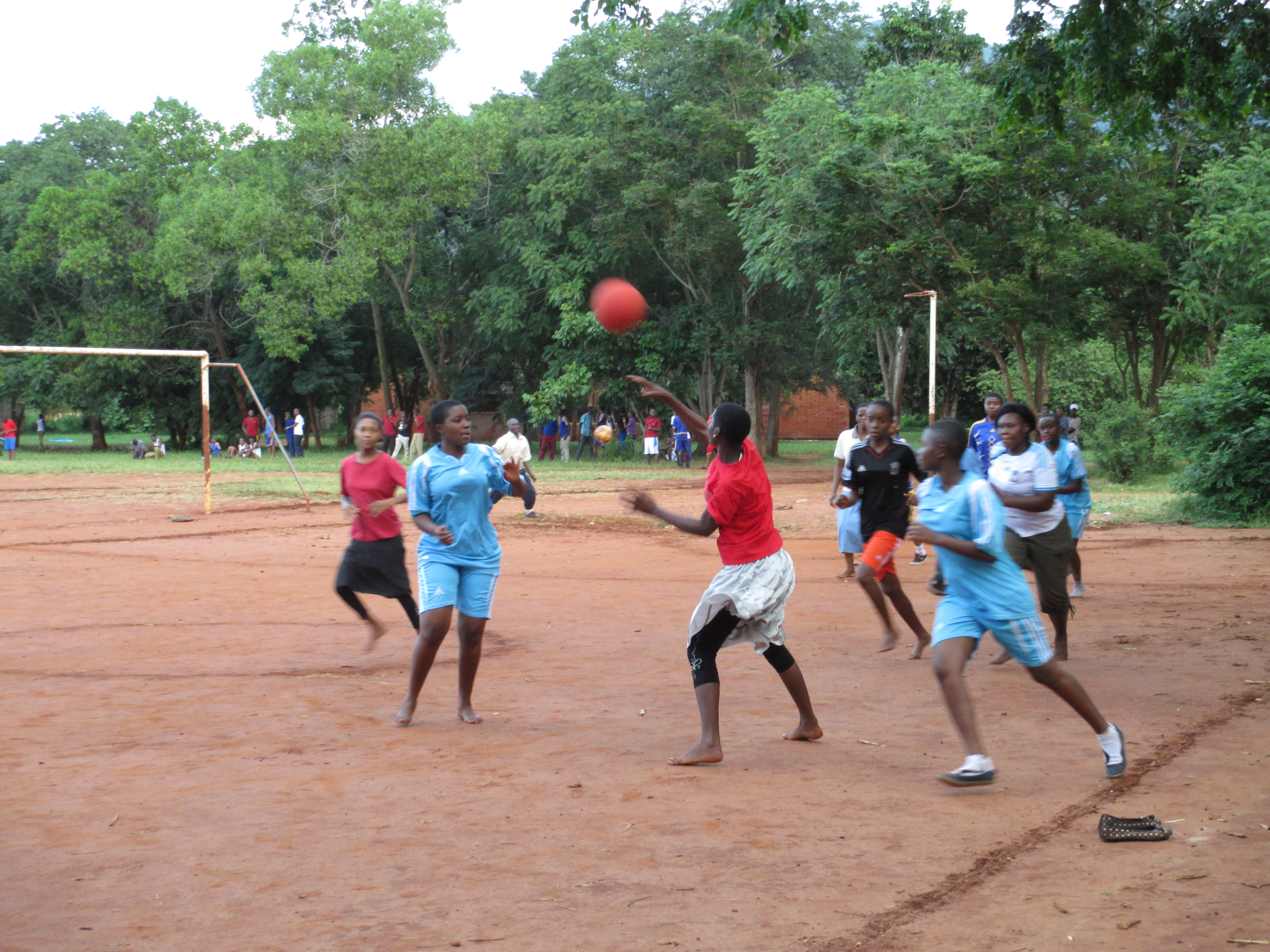
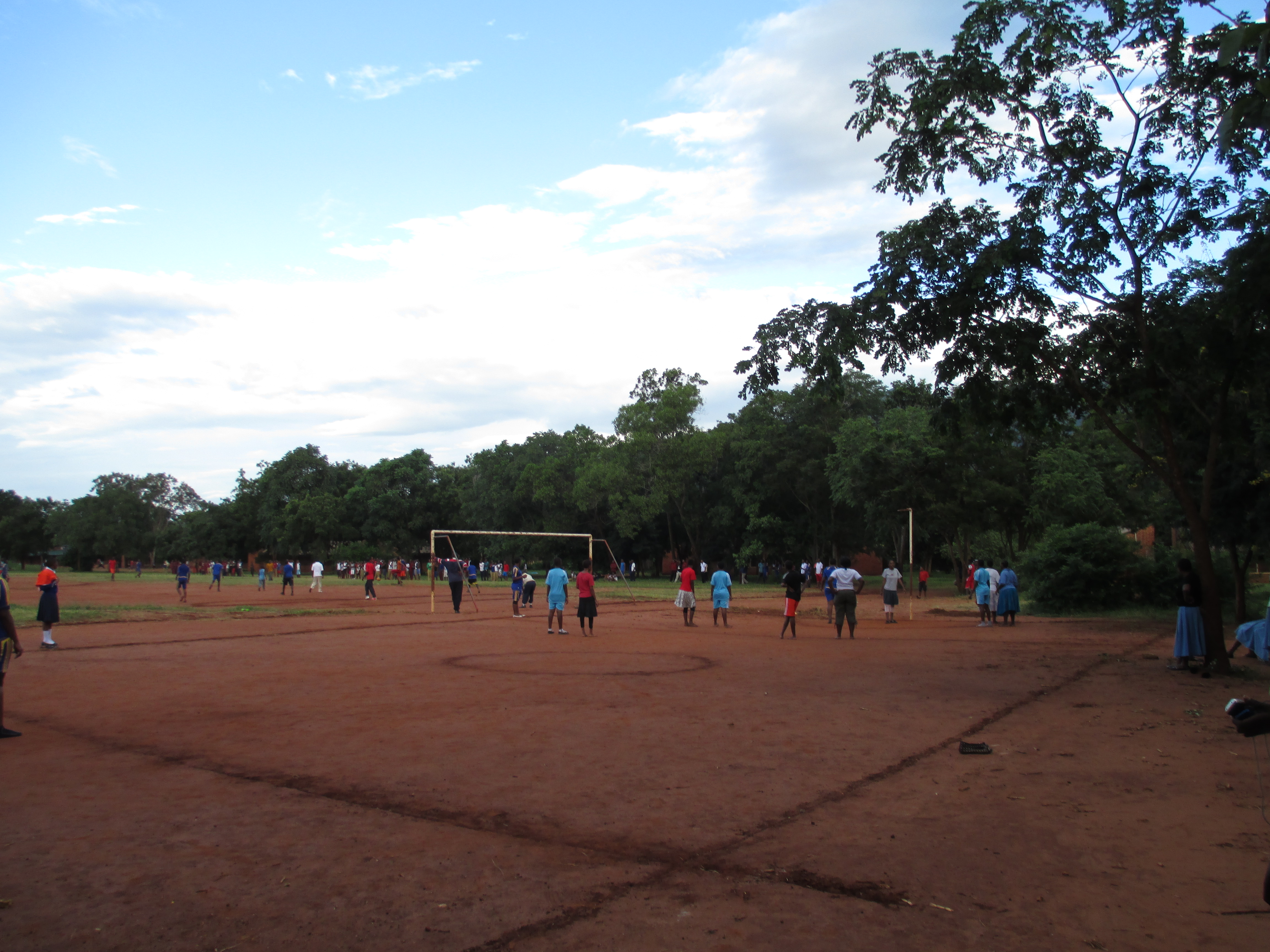
Today’s entry will be short and sweet.  I just returned to Morogoro, so between catching up with friends and sleep, there is not a lot to share.  However, tonight was the night of the student-teacher football match at the secondary school that shares a campus with our language school.  The field was packed with participants and spectators, and we could hear the cheering from the dining hall.  A few of us decided to wander over a take a look but were quickly distracted by the goings-on at our end of the field.  The football match was made up entirely of boys, but on a small, make-shift basketball court on the near end of the clearing, a group of girls and women were engaged in what at first glance looked like a pick-up basketball game.   I love basketball, so naturally my curiosity was peaked and I went over to watch.

Quickly I saw however that it was unlike any basketball game I had ever played.  There were too many players on the court.  The players didn’t move around the full length of the court, but rather seemed to stick to certain areas.  About half the girls were wearing soccer uniforms, so we determined that they were one team- the students- and that the teachers in street clothes made up the other team.  Many played barefoot.  Instead of dribbling (which would have been difficult on the dirt ground), the players would stop as soon as they received the ball and would not move until they could pass it up the court.  Once the ball made it to the end, the ball was passed to a player inside a small half circle outlined in the ground.  No other player entered the half circle, and the player, without jumping would throw the ball up and try to score through a metal hoop with no net.  At first, I was confused.  Was this basketball with concessions made to the limits of the playing surface and lack of a backboard?

Calling over to one of the students, we asked her what they were playing.  “Netball,” she replied.  I had heard of netball, but since girls in the States have played basketball for several decades now instead, I didn’t realize that it was still popular in other areas of the world.  She laughingly told us we should join in, but since we didn’t know the rules and it was really an event for the students and teachers to bond, we declined and stayed on as spectators.

May 105 May 100May 102  May 098  May 097May 104 May 096 May 094

Saying Goodbye…For Now

A funny thing happens when you travel or are living abroad.  Emotions seem heightened, friendships are made quickly, and relationships tend to be  accelerated.  As I prepare to leave tomorrow, it amazes me how sad I am and how much I feel I will miss the friends I have made here while I’m home.  I have been lucky to meet some wonderful people and a welcoming community here at the language school/Morogoro, and in particular, a group of girls that are close to my heart.

On another note, I have found myself really becoming attached to Tanzania.  And if I can make a confession, I wasn’t sure that I would.  My first extended trip abroad was for three months, to Bolivia.  I loved it.  I really truly, deep in my bones, loved it.  I still feel slightly heart-broken when I think about the fact that I haven’t been able to go back since.  The first two times I came to Tanzania, I didn’t feel that way.  Granted, they were short trips and as a cold-weather person, it is not my favorite climate.  Now, I certainly didn’t hate it; the people are just incredibly warm and welcoming and it is a beautiful country, so it’s hard not to see the positives.  But I didn’t feel that deep connection that I had felt in Bolivia.  So it was with some trepidation that I planned to move here for ten months.  However, over the past three months, it has, almost without me realizing it, grown on me so much that I know I will miss not only my friends but the country itself.  As I learn the language, it just becomes a better and better experience.  I leave tomorrow for Dar es Salaam in the morning, and then fly back to the States tomorrow night.  I’m excited to see my family and to have time to figure out what’s going on and recover.  But I can’t wait to come back.

Earlier this week, I had a little going away dinner with my wazungu friends at my favorite Indian restaurant in town.  Stephanie, in an amazing feat, made me a gluten-free chocolate cake (it is truly hard to impress upon you, dear readers, how ambitious this was to attempt here), which was delicious.  It was a great night, and still enough hours away from my departure for it to not seem real.

IMG_0395

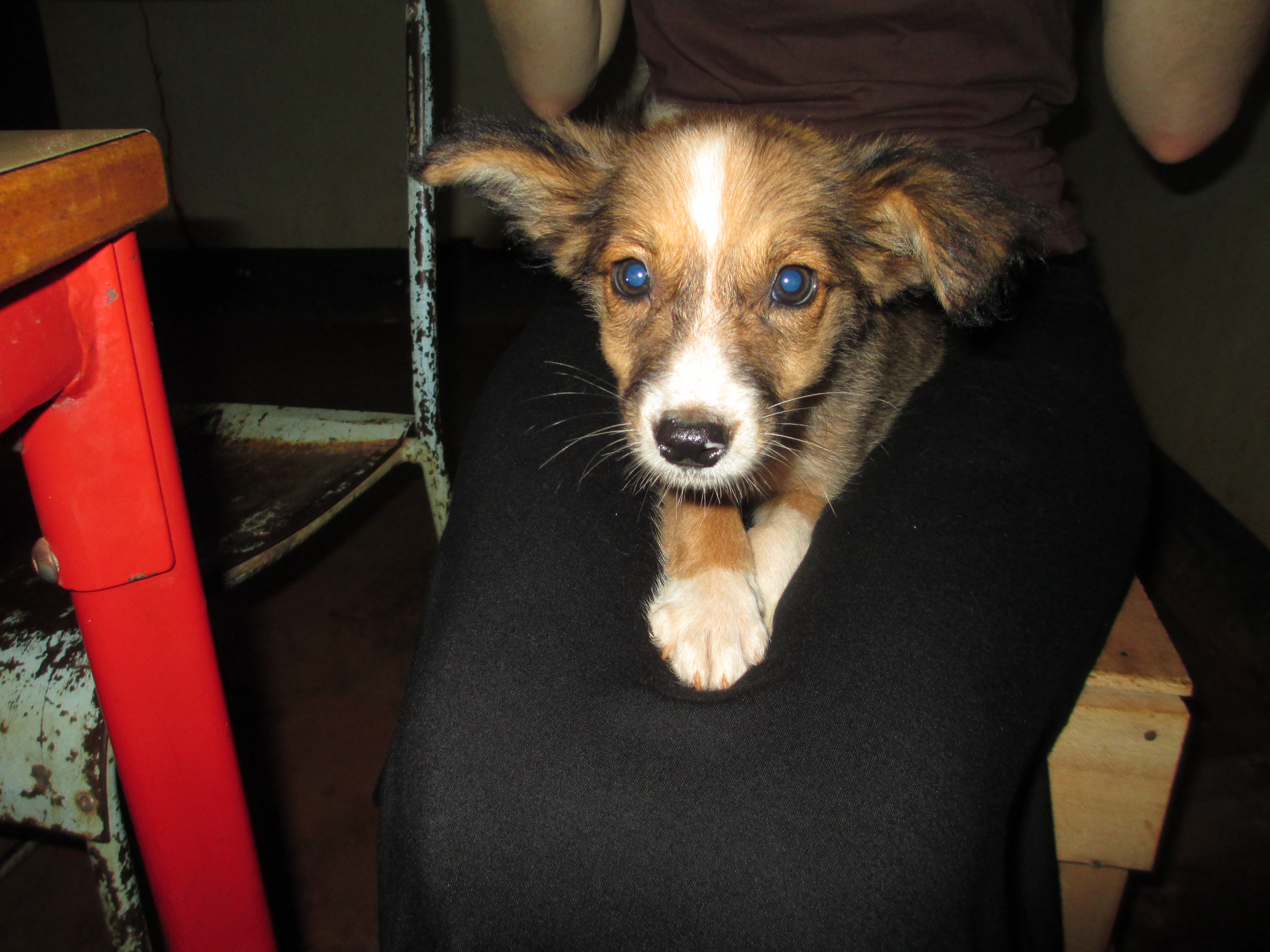
Tonight, some of the teachers and students at the language school got together because not only me, but two other students were leaving this week.  The teachers had us over to their house for refreshments and we had a great time just sitting around, talking, and listening to music, in the company of Soulja Boy, the Tanzanian puppy.  He belongs to one of my friends, Joseph, a teacher at the school and a big music fan.  Since he was set on naming him after a rapper, Anne and I were hard-core lobbying for Snoop Dogg, but alas, Soulja Boy won out.  I have known Souja Boy since he was just a week old, and am happy to report that he is growing into a fine young pup who can be seen showing off his posing skills in the picture below.  And now, I am off!
IMG_0404 IMG_0406 IMG_0410IMG_0400IMG_0408IMG_0411 IMG_0409

Cooking Up A Storm

IMG_0343 IMG_0344 IMG_0354

I love to cook.  LOVE IT.  Well, I love most things related to food, but I really love the act of actually preparing food.  It’s one of those daily tasks I miss most in Tanzania.  Right now, I am staying at language school where meals are provided for us, but I am hoping to do more cooking once I move to Ifakara.

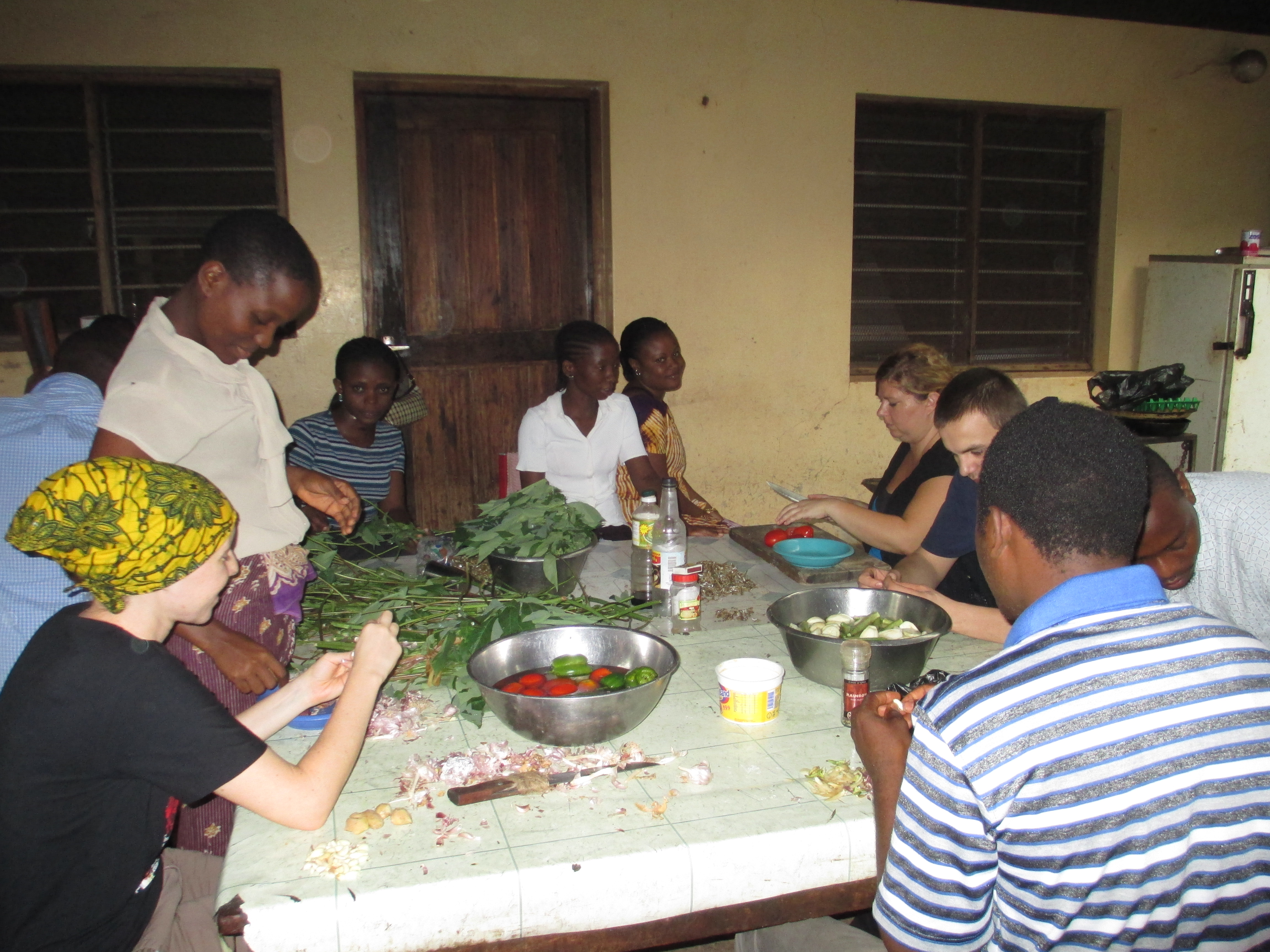
However, the language school has a tradition of holding a cooking day during each course, where the students make foods from their own countries.  Although we have quite a few students, it actually boils down to only a handful countries: the US, Germany, Finland, and South Korea (Actually, we have students from Croatia and India too, but they elected to just help with preparations).  We decided it made sense for each to group together and decide on one dish from each place.  The Tanzanians would also cook some foods that we hadn’t gotten to try yet, and then we would have a big meal together.

Kim, from South Korea, decided to make fried chicken drumsticks in a soy sauce with vegetables.  The Finnish couple couldn’t join us for cooking, so they just brought some items from town.  The Germans made a dish called “Farmer’s Breakfast,” which was a bacon and potato egg scramble.  And the Americans, you ask?  We made tacos.  Nothing says traditional Stateside fare like tacos.  But seriously, this was largely a concession to me, for which I am forever grateful to my fellow Americans here.  See, I love Mexican food (and yes, I realize I’m talking about Mexican food in the States, don’t get all huffy about it not being “authentic”).  Particularly spicy Mexican food, and particularly tacos. And I’ve lived in Colorado for the past seven years, which means I’ve had access to pretty quality Mexican food.   If I could only eat one type of food for the rest of my life, it would be Mexican.  If I could only eat two types of food for the rest of my life, it would be Mexican and sushi.  But for what I’m sure you can imagine are obvious reasons, sushi was not a practical choice in this case.  Because of this, and because I am slightly food-obsessed, I have not shut up about missing spicy Mexican food since I arrived.  Of course I don’t do this in front of the ladies who cook our food- the reality is that the food they make for us is good and filling and I really appreciate their effort and tell them so.  BIMG_0358ut yes, I have been guilty of moaning a bit when it’s just us students and we’re talking about things we miss from back home.  Okay, maybe more than a bit.  So my fellow Americans decided to make tacos for our dish (in fact, they made this decision while I was in my room sweating out the malaria so it may have been not only to shut me up, but also out of pity).  I quite literally got tears in my eyes when I heard.

IMG_0341

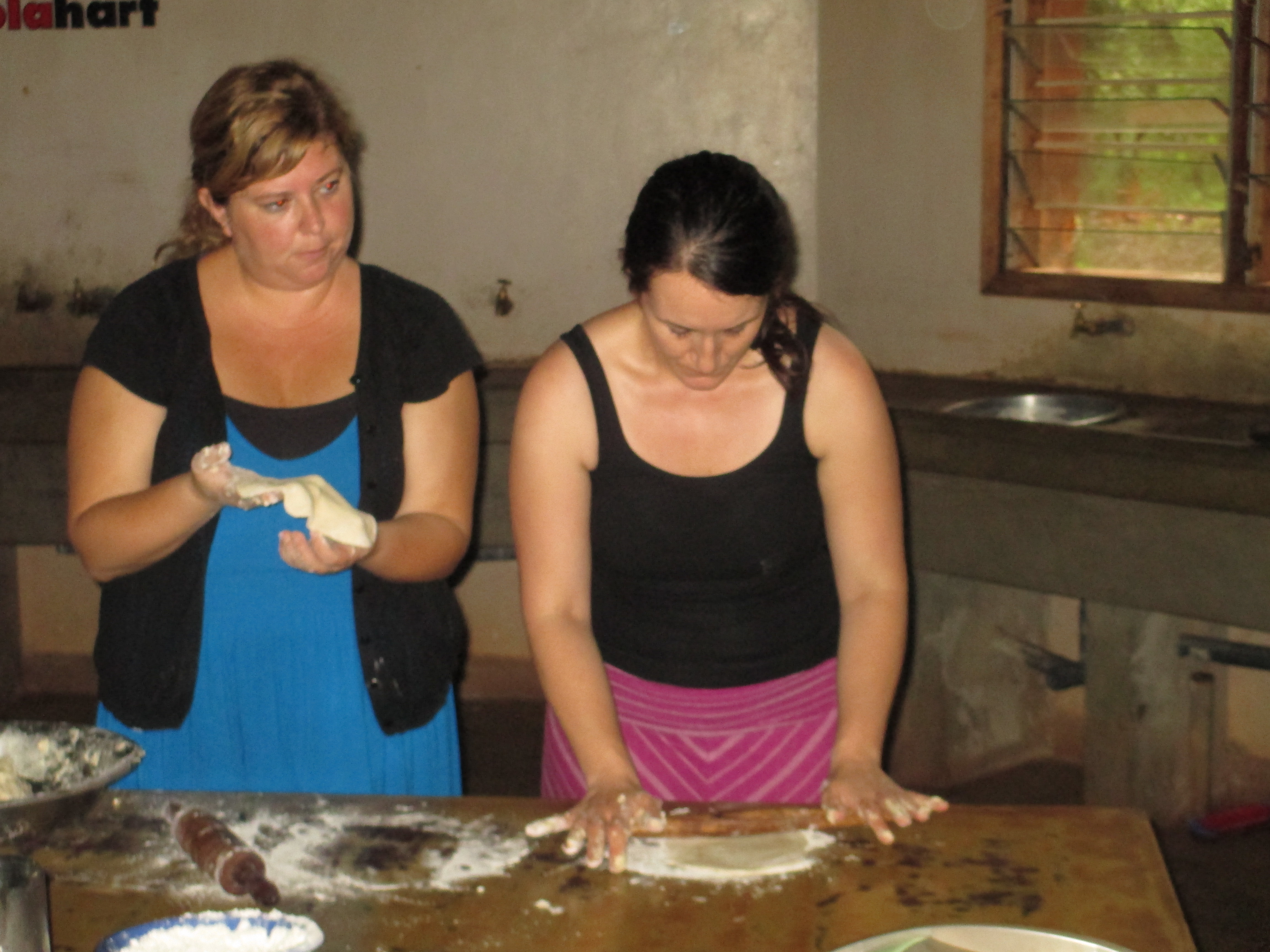
Of course the one sticky part of this equation is that we had no tortillas.  They make a delicious thin flat bread here called chapati but it is thicker and a bit greaser.  I was determined though, so I just told them to pick up some flour in town and we would figure it out.  I forgot to specify corn though.  I’ve lived so long in Denver that it hadn’t occurred to me someone would hear “tortillas” and assume that meant wheat.  But it is the thought that counts, and I certainly wasn’t going to let that bar my enjoyment of the dish.  So while the other students sat out in the open-air part of the kitchen chopping vegetables, Shantelle and I took over a table inside to get going on the tortillas.  The Mamas watched us curiously and made suggestions as to water to flour ratio, but we soon had a system going.  I was in heaven.

Agnes, one of our teachers, came over to help out while Shantelle started up the charcoal stove outside.  After a bit of silence, and noticing the smile on my face, she asked me, “You are happy?  You like this?”  I assured her I did, saying, “I love to cook.  It is one of my favorite things.”  More silence.  I could see her with a furrowed brow, occasionally shooting me sidelong glances.  “I thought,” she started, “I thought Americans do not cook.”  “How do you think we eat?”  I asked.  She told me that she thought Americans only went to restaurants, for every meal.  It’s not surprising IMG_0367since here in Tanzania most Americans either actually DO do this, or else hire cooks.  “No, many Americans cook.  My family likes to cook.  There are people who only go to restaurants, but most Americans cook also.”  “Kweli?” (Really?) She said, surprised and as if she did not quite believe me.  She laughed a bit to herself and we moved on, but it was one of those moments that really highlighted to me how the U.S. is perceived from the IMG_0360outside versus the reality.  Since I have been here, I have heard so many statements, said confidently, from Tanzanians about the US.  All Americans are rich.  All Americans have big houses.  All Americans own their own house.  All Americans have cars.  All Americans can afford whatever they want to buy or can afford to go wherever they want to go.  When I have contradicted these statements, or gently pointed out the diversity that actually exists in American lifestyles, or the idea of relative wealth, I am met with surprise or argument.  Particularly my position, as a student with very little disposable income, is a source of frustration.  IMG_0361If I can afford to come all the way to Tanzania, how can I not have money to give to people?  I have a computer, an i-Pod, an e-reader.  Why do I refuse someone who wants $50 or $100 for their children’s school fees or $70 for their daughter’s Send-Off?  Trying to explain that two were gifts and the third took me forever to save up for, that I am funded to be here and on a very strict budget, that I have to track each dollar, that I have student loans, that yes, here I am comparatively well-off, but in six months I will be back in my own country without a job or income where I am not well-off, is difficult with my limited Swahili.  Or that if I gave money to every person that asked, I would quickly be in deep trouble. Of coursI realize my financial situation is better than many here, I’m not trying to play it off as though it’s not.  And of course, not all Tanzanians hold these views.  Many have been to the US or have siblings, aunts, uncles, etc. somewhere in the States.  Many are educated and knowledgeable about the US.  But I hear these things often enough to struggle with how to talk about it.

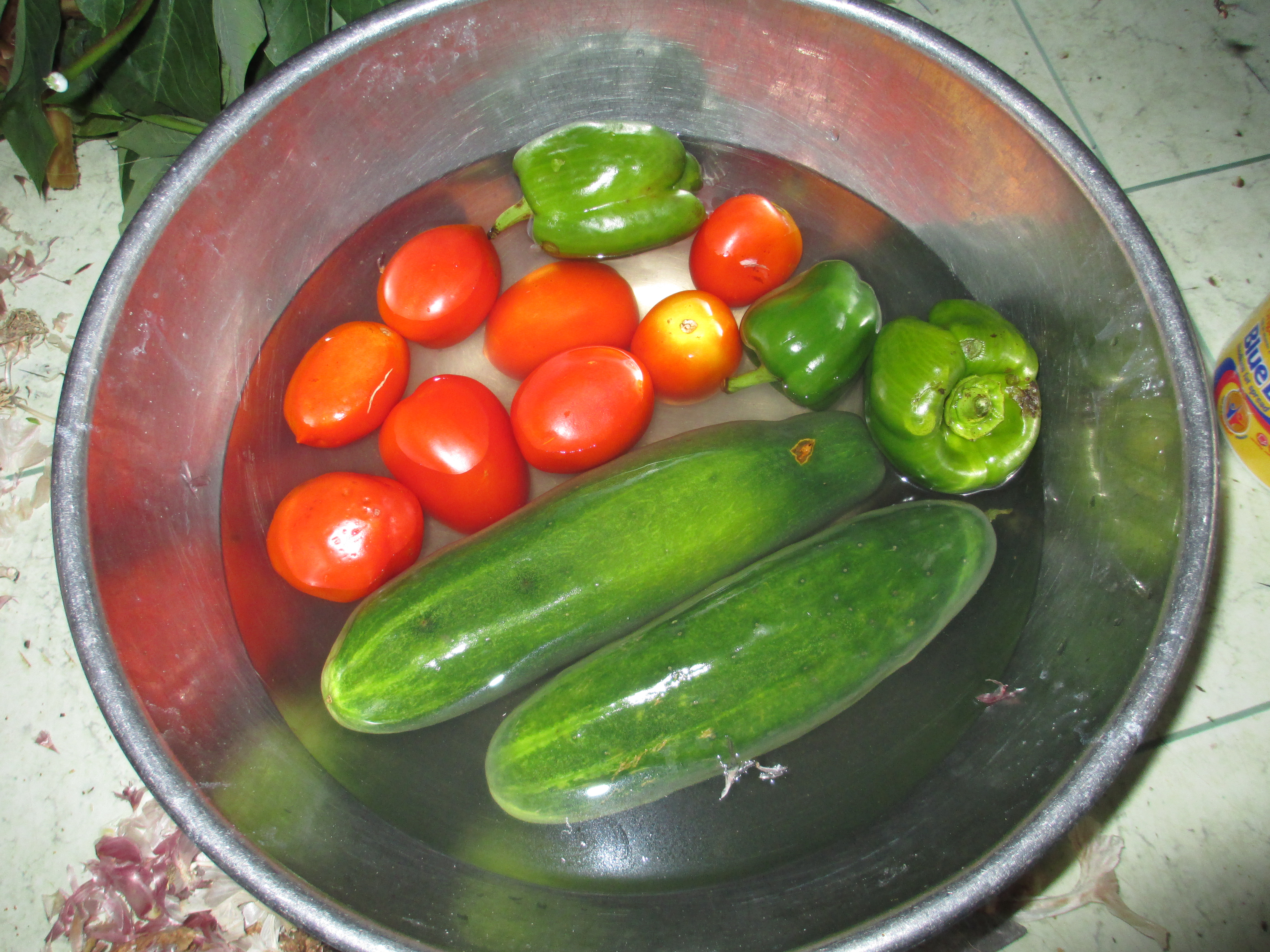
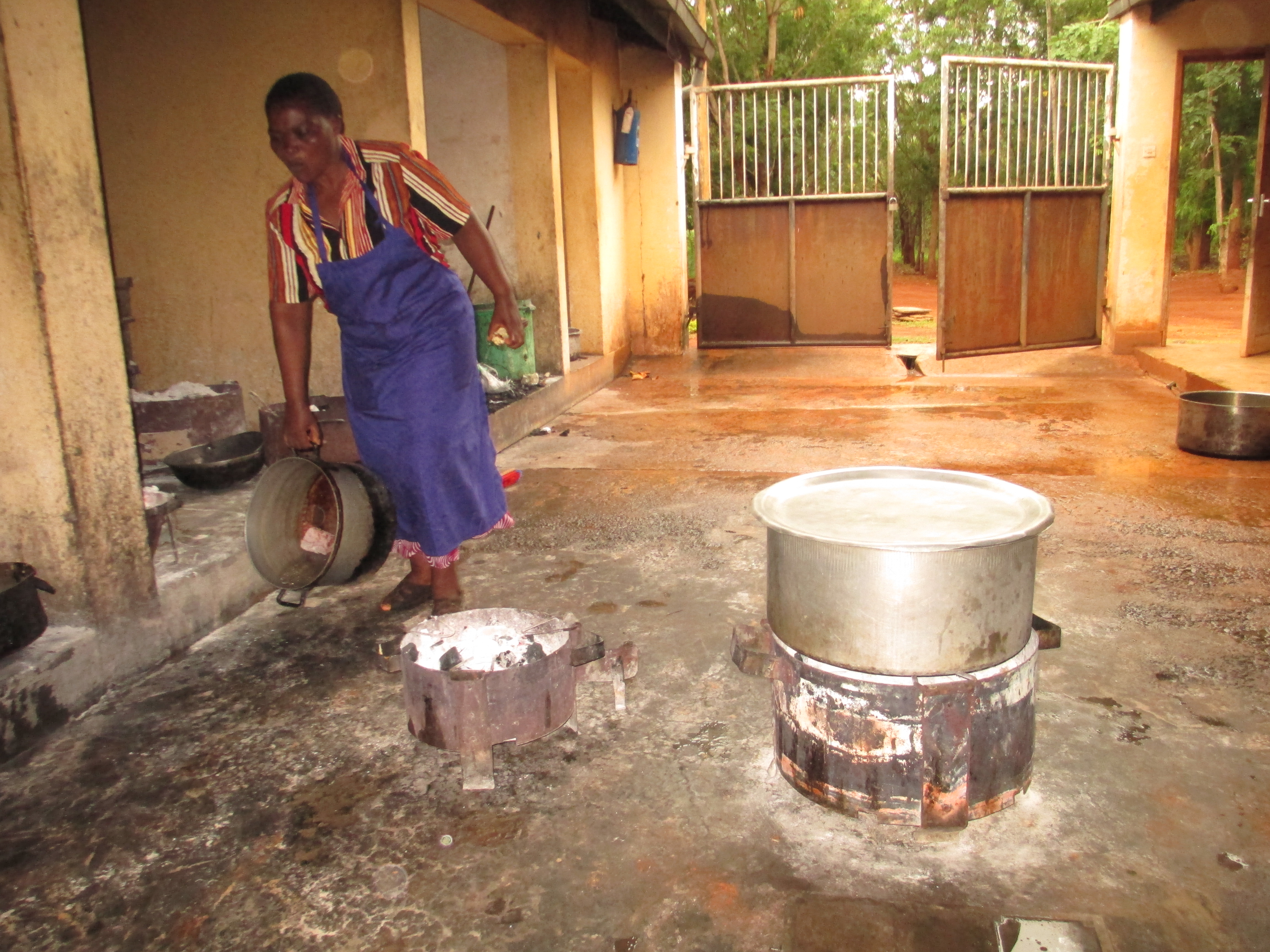
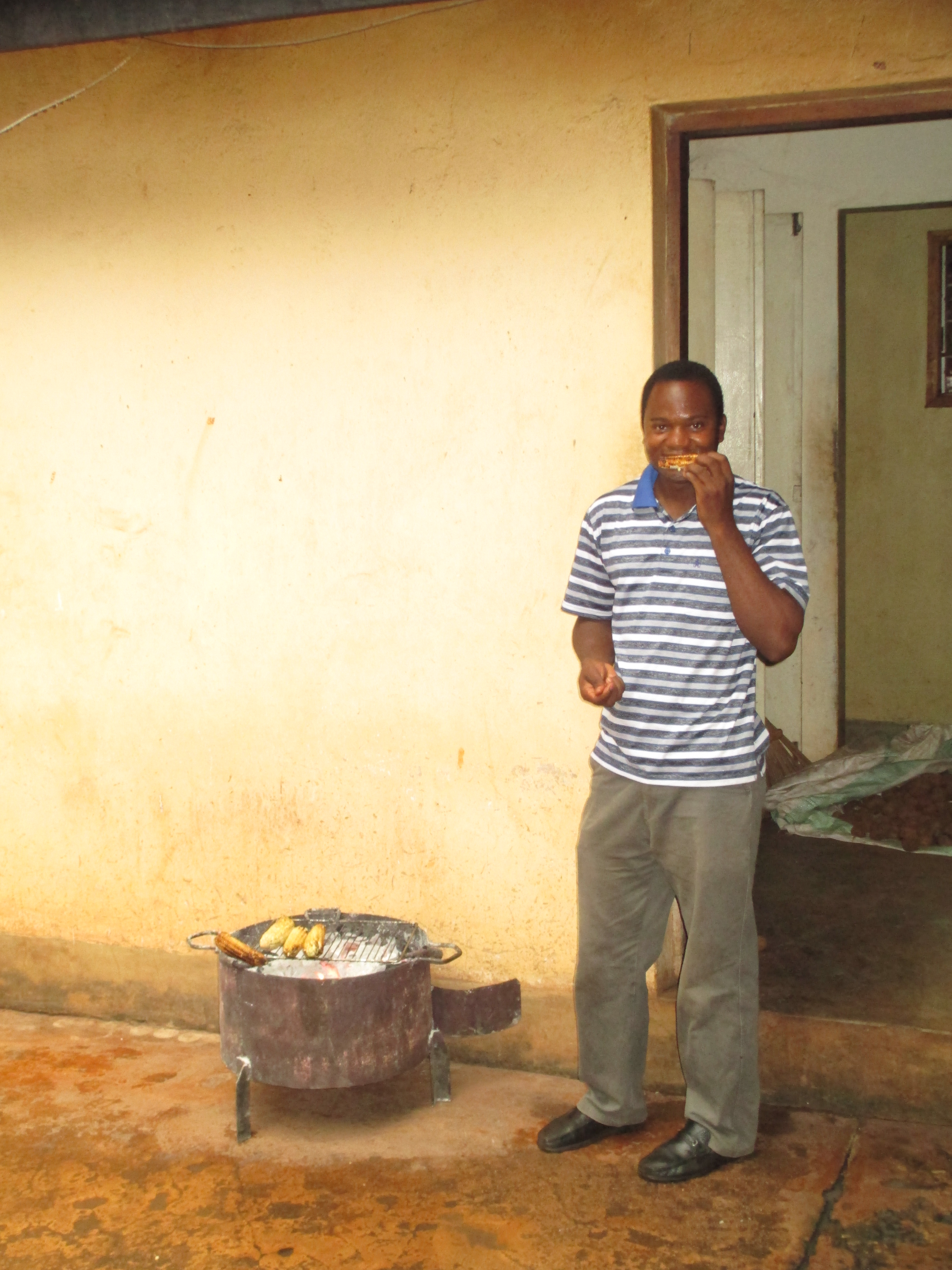
But back to cooking.  By this time, we were making good headway.  Shantelle had almost finished up the tortillas, I was overseeing the production of the make-shift pico de gallo (this mostly consisted of watching Jerianne chop vegetables while I compIMG_0363lained about my malaria hot flashes), the Germans had their dish sizzling in a pan, and some of the female teachers were watching Kim with an air of incredulity as he expertly showed off his knife skills (most cooking is done by women here, I’m not sure they believed how good he was).  Geoffrey manned the grill to whip up some corn as a snack, while another teacher demonstrated how to use a giant mortar and pestle to crush the leafy greens IMG_0349piled high on the table.  We cooked using charcoal stoves, so it took some time and a lot of creative logistics to get everything prepared and ready to eat at roughly the same time, but at last we were done!

Pictures were taken, and a prayer said.  The dining hall was full with far more than just the usual handful of students who board at the school.  In the spirit of the event, I took a tiny bit of everything, but the bulk of my plate, the place of honor, was saved for two exquisite tacos.  Flavored juicy beef, a bit of avocado, Pico de gallo stacked high, all wrapped up in a home-made tortilla.  And on top?  A bit of Tabasco Chipotle sauce, sent from the States by my wonderful mother.

IMG_0352

Part II: Attending a Send-Off

Hey!  Come here.  Let me tell you a secret.  Something I bet you never would have suspected.  Are you ready?  Here it is.  Malaria is…NOT…fun.  I know, right?  Who would have thought?!?

I really shouldn’t complain too much.  I have a mild case.  The pounding headache is really no worse than what I put up with during the usual migraine.  Sure, I feel like every single movement requires Herculean strength and yeah, my entire body aches worse than the time I decided it would be a great idea to do a metric century road bike race despite never having ridden more than 40 miles in one go (and that only once).  But really, as far as health issues run, I’ve had worse.

Except, that is, for the sweating.  And the subsequent chills.  And the sweating.  And the chills.  And the sweating.  And the chills.  On endless repeat all day, over and over again.  I am literally just sitting at my computer, barely moving except from the middle knuckle of each finger on down.  And yet, two minutes ago, I suddenly found myself drenched in sweat for absolutely no reason.  In a bit, I will just as suddenly get goose bumps and start looking around for a scarf.  It.  Is.  Miserable.

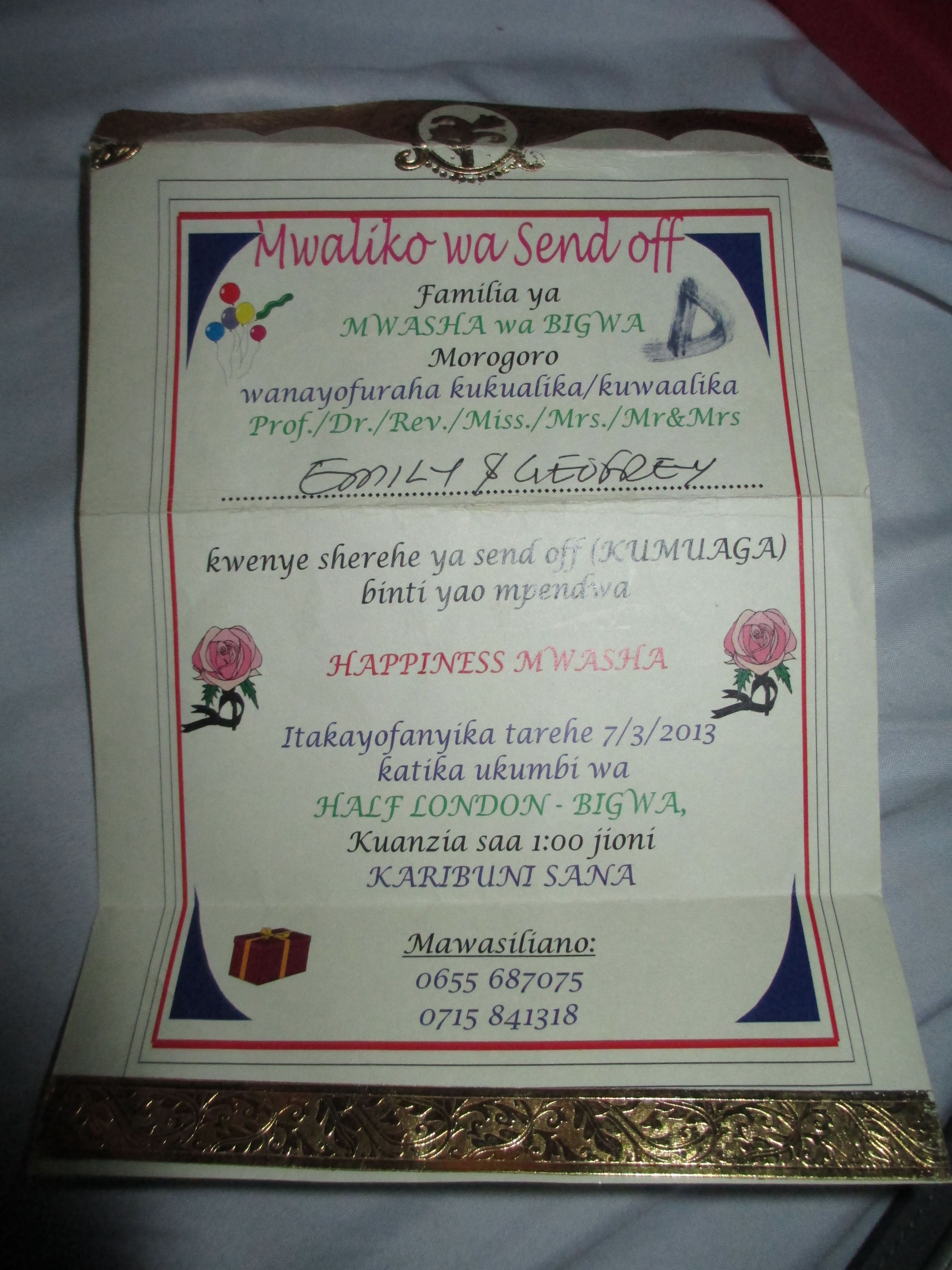
But, I had somewhere to be last night.  I had delayed my whole trip to IfakaraIMG_0553 by a week to attend the Send-Off party of Happiness, one of my teachers.  Happiness is getting married soon, and the Send-Off was described to me as sort of the Tanzanian equivalent of the American bridal shower.  In retrospect, I would actually describe it as more like a giant Sweet Sixteen party or Quinceñera in scope, but it is similar in that the focus is indeed on the bride.  I did not want to miss this.  Furthermore I couldn’t miss it as Geoffrey, another teacher, and I were on the same invitation because we paid together (attendees contribute money towards the cost of the party); I was currently in possession of that invitation which was needed to get in.

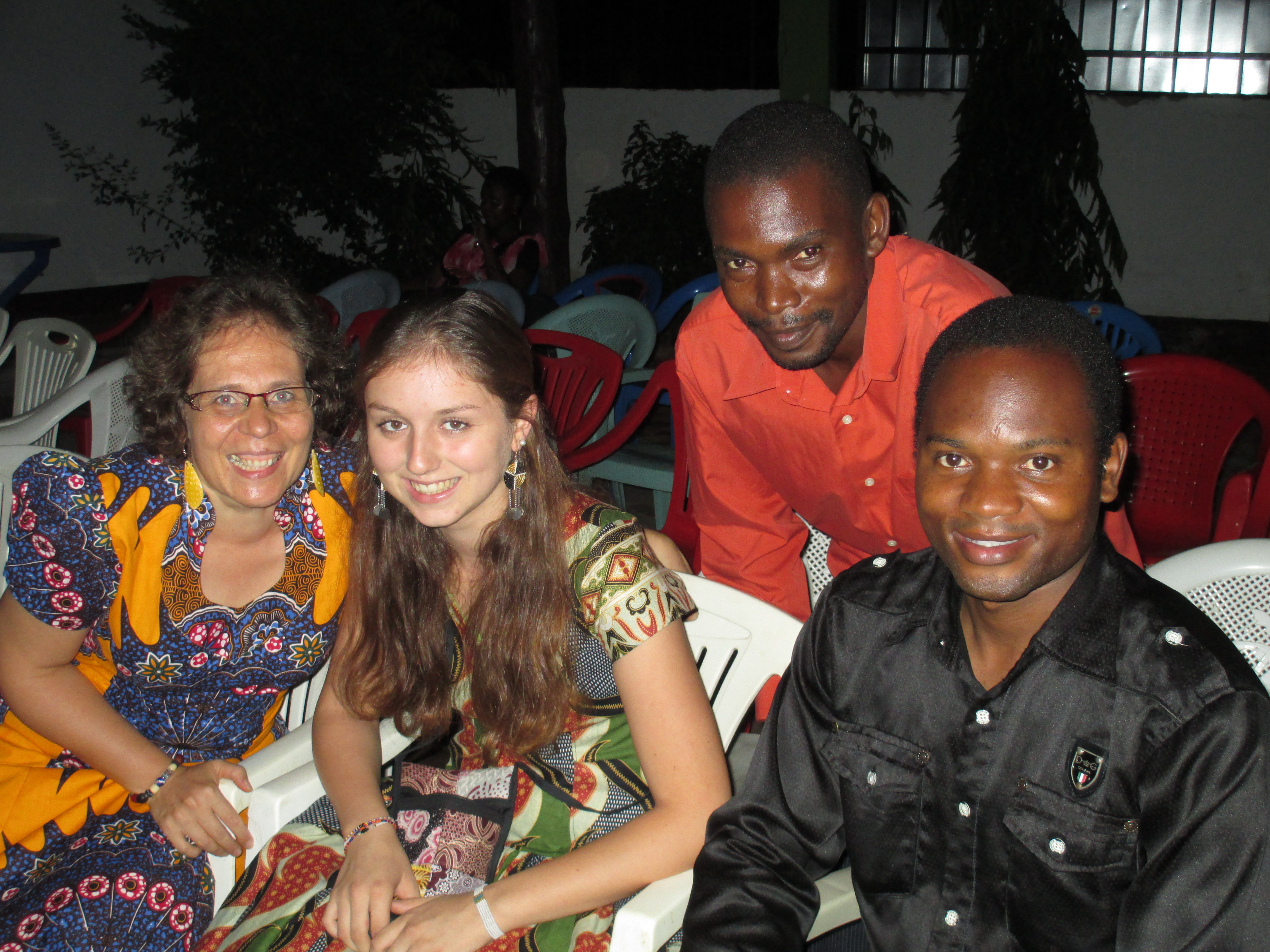
So, with plans to go for an hour or two and take a taxi home early, I got myself prettied up and headed out with Ingrid, Anne, Geoffrey, and a few other folks.  When we arrived, the venue was lit up with strands of lights and music was blaring.  Chairs were set up in rows facing the anterior of the room, with an aisle down the center.  Up front, a dance floor took up most of the space, with three smaller rows of chairs on either side, set at a right angle to the larger rows.  And finally, in the place of honor at the very front, a raised platform supporting a cloth-covered table and two chairs.  The entire stage area was decorated with lights, flowers, and pink bunting.

IMG_0321

A pink theme!

IMG_0323

Ingrid, Anne, Abraham, and Geoffrey


As people arrived, we amused ourselves dancing to the DJ.  Given that I had malaria, I was happy that dancing primarily consisted of swaying from side to side and, occasionally, forming a circular conga line.  With one amazing, fantastic exception.

There I was, just minding mIMG_0329y own business, getting my sway on, when suddenly the music segwayed into a new song.  Suddenly, as if on cue. the entire dance floor broke into the Hustle, not missing a beat.  Ann was slightly bemused for a few minutes- perhaps the Hustle hasn’t made it to Germany, but I reassured her, “Don’t even worry about it, just watch me.  I spent the better part of two years attending Bar and Bat Mitzvahs growing up.  I’ve got this.”  Confidently, I merged into the crow, ready to wow with my slightly jazzed up Hustle dance moves… and then ran into two people because apparently the Tanzanian hustle is not the same as ours.  Don’t get me wrong, it is close.  But, three steps where we take four in one place, an extra dip thrown in another; it was just enough to make me look like an idiot.  But!  I am no line-dancing novice.  I stepped out for one sequence and soon enough I was back in there, shaking things up.

Slowly the crowd had built andIMG_0325 so we made our way back to our seats.  A band led off, sporting hot pink ties.  Moving up the aisles, they had everyone moving.  What followed was far more involved than a simple bridal shower and there is far too much detail to go into here but I will give a few highlights.  A large group of girls dressed alike came up the center aisle, something like the equivalent of bridesmaids, followed by the bride herself.  IMG_0330She was accompanied by a young woman who was dressed like her in a shiny pinkish-gold dress made in the Tanzanian style who stayed by her side most of the evening as a Maid of Honor.  For some time after, it was primarily about the bride, who stood up front while various family members and the MC made speeches.  The bride’s family sat on one side of the dance floor, while her husband’s sat on the other, and both were in great spirits.  Finally, at one point, the groom came into the back of the room.  Rather than join his bride up front, however, he hid in the audience.  Tanzanian Send-Off custom, I’m told, calls for the bride to “find” her groom.  Happiness, slowly roamed around the room, feigning ignorance of her groom’s location.  Up and down the room she went until finally, she located him two rows behind us and everyone clapped and whooped.

IMG_0336

The happy couple!